Every e-commerce business’s calendar has certain times of the year that account for a disproportionate share of the year’s opportunities: Black Friday in November, the Christmas and Three Kings’ Day season, the January sales, Prime Day in July, the summer sales… And with each of these dates comes the same question: Is it worth participating? And if I don't, what am I really missing out on?
It’s a legitimate question. Not all brands should do the same thing every season, and choosing not to participate can be a strategically sound decision. But—and here’s the catch—that decision has to be based on the numbers, not on intuition or accumulated fatigue. Because one thing is certain: Your customer will be shopping during that time. The question is whether they'll shop at your store or the one next door.
The Numbers That Change Your Perspective
Before making any strategic decisions, look at the data. And the data on the e-commerce peak season in Spain is, quite simply, hard to ignore.
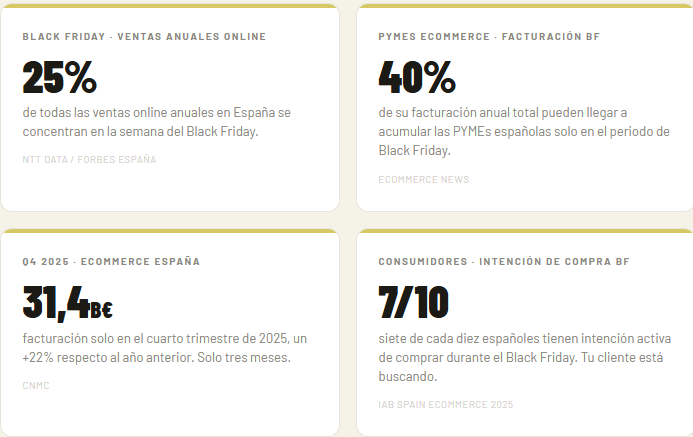
E-commerce in Spain exceeded 114,800 million euros in 2025, a 20.6% increase from the previous year (CNMC / El Debate, July 2026). Of that figure, 31,418 million were attributable to Q4 alone, which represents 27% of the annual total (CNMC, Q4 2025). And that’s just the last quarter: to that figure, we must add the boost from the January sales, Prime Day in July, and the summer sales. These aren’t just any sales seasons—they’re *the* sales seasons.
From the consumer's perspective, the picture is just as clear: Seven out of ten Spaniards actively plan to shop on Black Friday, according to the IAB Spain E-commerce 2025 Study. These aren't people who might buy—they're people who have already decided they're going to buy. The only question is who they're going to buy from.
«More than a quarter of all online sales in Spain occur in the last quarter of the year. Add in the other peak seasons, and you'll understand why a seasonal strategy isn't optional.»
Your peak season isn't the same as your neighbor's
Black Friday is the most widely publicized date and the one with the greatest global impact, but anyone who thinks it’s the only one that matters is mistaken. Peak season is a concept that varies by industry: for a toy store, Christmas and Three Kings Day are the most important times of the year; for a travel agency, summer and Holy Week are unbeatable; for a sports brand, New Year’s resolutions generate a surge in consumer interest that lasts for weeks.
Understanding when your peak season is—and planning for it well in advance—is the first strategic move of the year. Selling fashion is not the same as selling technology, toys, beauty products, or food. This table lists the main e-commerce sectors in Spain, their peak sales periods, and the estimated share of Q4 in their annual sales:
| Sector | Major Peak Seasons | Estimated Q4 share of annual sales |
| Fashion and Textiles | Black Friday – Christmas – Sales – Back to School | ~35% |
| Electronics and Technology | Black Friday – Christmas / Three Kings Day – Back to School | ~40% |
| Toys and Games | Christmas / Three Kings Day – Black Friday – Back to School | ~55% |
| Travel and Tourism | Summer (July–August) – Christmas – Holy Week – Black Friday | ~20% |
| Beauty and Cosmetics | Black Friday – Christmas – Valentine's Day – Summer | ~32% |
| Sports and Outdoor Activities | New Year (Resolutions) – Spring – Black Friday – Back to School | ~25% |
| Home and Decor | Black Friday – Christmas – January Sales – Spring | ~30% |
| Gourmet Food | Christmas – Easter – Halloween – Black Friday | ~45% |
| Pets | Black Friday – Christmas – Summer | ~28% |
The data in the table leaves little room for interpretation. The sectors of Toys and electronics account for between 40% and 55% of their annual sales in the last quarter of the year. In the gourmet food sector, that percentage is around 45%. The fashion and textile industries generate about 35% of their annual revenue between October and December. These proportions are so high that a poor peak-season campaign can affect the company’s year-end results.
The message is clear: regardless of the industry you're in, there are one or more times of the year when the market becomes exceptionally active. The most common mistake isn't missing Black Friday—it's missing your own peak season because no one at the company had flagged it as a problem early enough. The real question isn't whether you should take advantage of them, but how to do so in a smart and profitable way.
The Cost of Doing Nothing
Here comes the most uncomfortable part. Deciding to do nothing doesn't make you neutral: It makes you invisible precisely when you're getting the most attention. And being invisible at the moment when purchase intent is at its peak comes at a very specific economic cost.
Let’s think about what happens when a user who already knows you—someone who has visited your website and is in your database—enters shopping mode during Black Friday, the January sales, or the holiday season. They’re actively looking. They’re comparing prices. And if you don’t show up with an offer, a message, or a reason for them to choose you on those very days… they’ll go where that offer is available. And that means the competition.
The Triple Cost of Inaction
- Lost Sales at the Peak of Purchase Intent. Your customer is making purchases on those days, with or without you. Demand doesn't disappear just because you're not involved.
- Loss of Existing Customers. A customer who shops with a competitor during peak season may stay with them. Peak seasons are also times for building customer loyalty and for switching brands.
- Wasted customer acquisition costs. If you've been investing for months in driving traffic and building a database, failing to activate that database during the peak conversion period is a waste of your previous acquisition costs.
Participating doesn't always mean lowering prices
And for those who believe that «not lowering prices» is in itself a valid strategy: it can be. There are premium brands that don’t want to devalue the perception of their product and businesses whose margins simply can’t withstand aggressive discounts. For them, the alternative isn’t to disappear, but to participate in a different way: free shipping, a free gift with purchase, early access to new products for customers, exclusive bundles, or a “Green Friday”-style promotion.
But that only works if you actively communicate. Silence is not a stance. If your customers don't know that your brand has something different to offer this season, they'll simply assume you've forgotten about them. And in e-commerce, neglect comes at a high cost.
Preparation vs. Improvisation: The Data Speaks for Itself
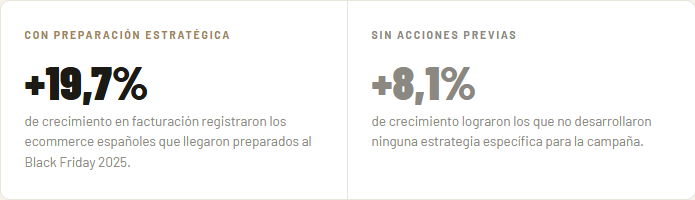
If the analysis of Black Friday 2025 in Spain makes one thing clear—and this pattern repeats itself during Christmas, sales, and any other peak season—it’s that simply participating isn’t enough: what makes the difference is how you participate. E-commerce businesses that enter the campaign with groundwork laid, a defined strategy, planned actions, and infrastructure in place achieve results that are radically different from those who improvise in the final week.
Source: Periódico Publicidad / Study on Spanish e-commerce during Black Friday 2025.
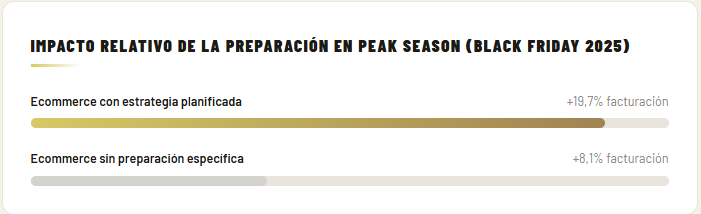
The gap is more than double: A +19.7% increase in revenue for e-commerce businesses that came into the season with a planned strategy, compared to +8.1% for those that did not prepare any specific actions. And that’s just in terms of revenue growth. If we factor in the number of orders, the difference is even more pronounced: e-commerce businesses prepared for the campaign saw their orders grow by +63% year-over-year, compared to the average market growth.
«The difference between a profitable peak season and a mediocre one isn't the discount percentage. It's the 60 days leading up to it—and who came up with the strategy.»
So, what does planning for the peak season really entail?
A strategy for Black Friday, Christmas, the January sales, or Prime Day nOr put up a banner that says «−20%» three days before. That's what most people do. And that's why most people get mediocre results: they bring in less revenue, squeeze their margins, and don't attract a single new customer they wouldn't have attracted anyway.
A real strategy involves:
- Preliminary Analysis: What worked last year? Which customer segments shop during this time of year? Which of your products have the highest margins, and which have the highest conversion rates?.
- Setting Specific Goals: Are you looking to increase sales volume? Attract new customers? Clear out inventory? Reactivate a dormant database? Each goal requires different tactics.
- Channel Planning and Budgeting: paid media (Google, Meta, TikTok), email marketing, automations, seasonal SEO, marketplace. Everything must be coordinated and have a budget allocated weeks before CPCs go up.
- Publishing and Creative Calendar: Visual materials, copy, landing pages, and email sequences must be ready beforehand, not while the campaign is already running.
- Technical Specifications: Page load speed during peak traffic, inventory management, remarketing flows, and properly configured pixels and audiences. This also includes Set up your Google Analytics 4 property for Black Friday.
- Real-time tracking metrics: to be able to make agile decisions during the campaign—increasing the budget where it works, deactivating what doesn't convert—and drawing lessons for the following year.
Why the team behind the scenes makes all the difference
Here's the question many people ask themselves but few voice out loud: Can I do all this in-house? The honest answer: It depends on your structure, but probably not in the best way.
Peak season compresses into a matter of days what would normally take weeks to adjust. Configuration errors in a paid media campaign During Black Friday, Christmas week, or the start of the sales, you can't «fix» things "tomorrow," because by tomorrow, the best part of the sale will already be over. CPCs are skyrocketing, competition for ad inventory is fierce, and the margin for error is minimal.
A professional team with experience during peak season brings something that can't be found in any manual: the pattern of what works and what doesn't, built up over the years and with a track record of working with brands across various industries. He knows which audiences to target at what time, how to structure discounts to maximize margins without undermining the perception of value, and how to segment the database so as not to overwhelm the most valuable customers with mass communications.
So, going back to the original question: You can run Black Friday, Christmas, or clearance sales—or decide not to. What you shouldn't do is let the date decide for you. Your next peak season is already marked on the calendar, and the 60 days leading up to it will be here sooner than you think. If you want to arrive with a strategy already in place—rather than improvising during the last week—at Geotelecom we'll help you Design Your Black Friday Strategy and the other key seasons for your e-commerce business.