If you have a website and are working on its search engine optimization, you've probably heard of the Google Updates: Changes that Google makes to its systems that can cause significant shifts in search results.
But not all updates are the same. Google performs Core Updates, which have a broad impact on their ranking systems, but also specific updates to combat spam and other more targeted changes.
In 2026, Google released several major updates, including various Core Updates and Spam Updates.
All of this is happening, moreover, against a backdrop in which search is evolving with artificial intelligence, and Google continues to adjust both its ranking systems and its policies regarding content created at scale.
What is a Google Core Update?
A The Google Core Update is a major update that Google implements in its search systems to improve the way it evaluates and ranks content. These changes can affect many pages and industries at the same time and cause fluctuations in search results.
Google uses numerous systems and signals to determine which results to display for each search query. With a Core Update, thoroughly review and adjust how these systems work, with the goal of providing users with more useful and relevant results.
Unlike a penalty, A Core Update is not targeted at a specific website or industry. As Google changes the way it ranks results, some pages may move up in the rankings while others may drop, even though the latter haven't necessarily done anything wrong.
That's why, after an update, we may find that Websites that gain visibility, others that lose it, and others where there are hardly any changes.
To better understand why these movements occur, you can read more about them on our blog at How Google's Algorithm Works.
Core Update and Spam Update are not the same thing
Although they can cause similar fluctuations in the SERPs, it’s important to distinguish between a Core Update and a Spam Update.
- The Major updates introduce sweeping changes to positioning systems from Google.
- The Spam Updates specifically improves its systems to detect practices that violate its spam policies. One of them is SpamBrain, Google's artificial intelligence-based spam prevention system.
Among the practices that Google considers spam are, for example, the misuse of expired domains, the misuse of a site's reputation, and the large-scale generation of content whose primary purpose is to manipulate search rankings rather than provide value to the user.
This difference is particularly significant in September 2026. The update that Google began rolling out on September 24, 2026, is a Spam Update, not a Core Update, so if we detect any movements over the next few weeks, we'll have to analyze them in light of that context.
How does a Google update affect your website's SEO?
The effect can vary greatly from one website to another. An update can result in changes in rankings, visibility, impressions, clicks, and organic traffic, but seeing a drop right after an update doesn't automatically mean that Google has “penalized” the page.
This is where it is essential to analyze the context.
We shouldn't just look at how much a domain has risen or fallen since the day an update began. We need to analyze what the trend was previously, which directories have changed, which URLs account for the losses or gains, and which search queries have been affected.
We must also compare which pages currently hold those positions. In many cases, this comparison provides a better understanding of what kind of result Google considers most appropriate for a given search intent.
Real-life cases: two different outcomes following the same update
At Geotelecom, we can see this firsthand in the projects we've been managing for years.
One of our clients, with whom we've been working since the start of their SEO strategy, has seen steady growth in visibility since 2022. During this time, we've worked on various aspects of the project, and more recently, we've revised part of the blog's strategy to address topics relevant to their potential customers that were still underrepresented in search results.
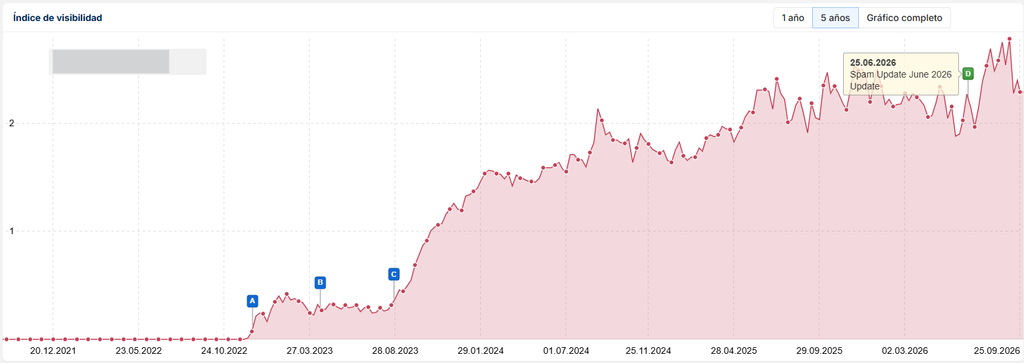
The The June 2026 Spam Update did not slow that trend. As can be seen in the graph, the domain maintained an upward trend in the following months and reached new highs in visibility.
This does not mean that we can attribute the growth solely to the update. A temporal correlation does not prove that a Google update is the direct cause of an increase or a decrease. What we can confirm is that the project continued to grow after the deployment and that the work we had been doing did not lose any efficiency after the change.
In another project, we encountered a different situation.
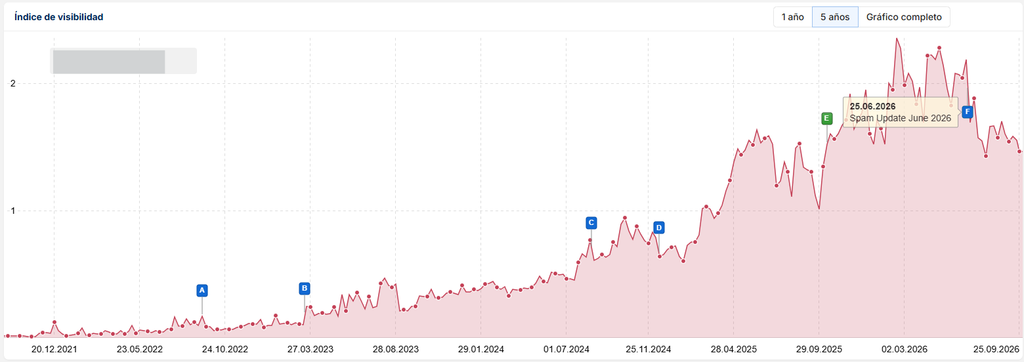
This sector had also experienced considerable growth in recent years, but Before the update, we had already noticed a drop in performance in certain areas, especially in some of the blog's content.
After reaching peak visibility during the first few months of 2026, a downward trend subsequently began. We are currently working on the areas where we have identified the greatest room for improvement, reviewing both blog content and product pages. and analyzing each one individually URLs and queries that have experienced a decline in performance.
Both cases illustrate an important point: We can't interpret a Google update based solely on the day it begins. The trends before and after, the affected URLs, and the changes in the SERPs are what allow us to make a much more reliable assessment.
The Role of Artificial Intelligence in Google Updates
The rise of generative AI has added another variable to SEO, but there is an important caveat: Google does not consider content to be spam simply because artificial intelligence was used to create it.
The goal of their policies is to use automation (including generative AI) to to produce large numbers of pages that offer no value to the user, with the primary goal of manipulating search results. In fact, Google makes it clear that large-scale content abuse can occur regardless of whether the content was created by people, through automation, or a combination of both.
Therefore, the debate should no longer focus simply on “Human-created content versus AI-generated content”, but rather what a page actually contributes.
Personal experience, original data, real-life examples, specialized knowledge, reliable sources, or an explanation that better addresses a specific need are elements that set one piece of content apart from another. Using AI as a tool does not eliminate that value; however, publishing hundreds of pages that are virtually interchangeable without adding anything new can indeed become a problem.
And what about AI Overviews and generative results?
Nor does the context end with traditional organizational roles. Google's search results page itself is evolving with features based on artificial intelligence, which changes the way users find and consume information.
Google maintains that the same SEO principles still apply to appearing in its generative experiences: creating content that is useful to people, making it easy for Google to crawl and index it, and complying with its policies. There is no separate technical optimization that guarantees appearance in these features.
This makes it even more interesting to provide information that goes beyond simply rephrasing what is already on other pages: professional experience, personal analysis, examples, images, videos, data, or specialized knowledge can make content truly useful.
What Should You Check After a Google Update?
The first instinct after noticing a drop is usually to start making changes to pages, but Making changes right away can make it harder to diagnose the problem.
Fluctuations are normal during deployment. Therefore, unless we detect an obvious problem that requires immediate action, it is more useful to wait until we have enough data and compare time periods.
In Google Search Console, we can analyze clicks, impressions, position, and queries, comparing performance before and after the update. An SEO visibility tool also allows us to quickly see whether the change affects the entire domain or is concentrated in specific areas.
But the most interesting analysis comes when we drill down to the URL level.
If the drop is concentrated in a specific directory, category, or certain types of content, that gives us a much more useful clue than a general loss of visibility. Then we can check Which search terms have changed, and which pages are now occupying the positions we used to hold?.
In a spam update, Google also recommends specifically reviewing its policies to ensure that the site is not engaging in any of the practices that its systems are designed to detect.
How do you recover a website after a Google update?
There is no universal action that allows you to restore your settings after an update. The solution depends on what has lost visibility and why.
If certain URLs have dropped in rankings, the first step should be to compare them with the results that now appear above them. The content may be out of date, may not align as well with the search intent, there may be a better alternative within the website itself, or there may simply be pages that provide more information and a better user experience.
Updating content isn't just about changing the publication date or adding a few paragraphs. In some cases, you'll need to remove information that is no longer relevant, update data, reorganize the page, incorporate personal experience, improve internal linking, or completely rethink the approach.
And we also have to accept that not every drop in rankings requires a “recovery.” If Google has started interpreting a search intent differently, a URL that used to rank well may simply no longer be the most appropriate result for that query.
That is why, An audit conducted after an update should look for causes, not just URLs that have dropped in rankings.
Google updates don't start on the day Google announces them
This may be one of the most important concepts for correctly interpreting a Core Update or a Spam Update.
The work involved in determining how a website responds to an update usually begins long before Google announces it.
The content we’ve been improving for months, the site’s architecture, internal linking, the quality of the product pages, the technical issues we’ve fixed or left pending, and the real value we offer users are all part of the context behind each update.
That's why there isn't a specific change we need to make every time Google releases an update. The important thing is analyze how it has affected our website and identify which areas actually have room for improvement.
At Geotelecom, digital marketing agency, we approach Google updates from that perspective: we analyze what has changed, which parts of each project have been affected, and what the data tells us before making decisions.
If, after an update, you've noticed a loss of visibility and need to know where it's coming from, our team at web positioning You can analyze the project and determine which areas are worth prioritizing.