In 2023, you asked a chatbot questions. In 2025, you asked it to do things. In 2026, Agent-based AI has begun to act on its own, to coordinate with other stakeholders and make decisions while you sleep. 2027 will be the year we see substantial changes in business processes.
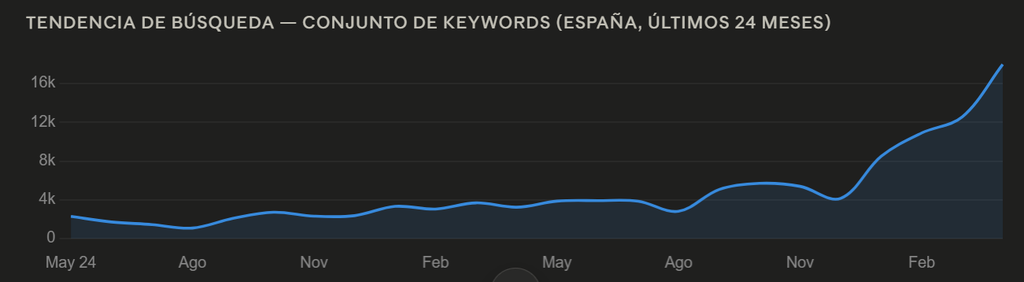
There is a precise moment when a technology stops being a trend and becomes infrastructure. For AI players, that moment is approaching: Searches in Spain for agentic AI have increased by +4.900% over the past two years, and overall interest in the concept has risen by +685% over the past 24 months. The keyword with the highest search volume is «AI automation» (2,400 searches/month), followed by «AI agents» (1,600/month), and «legal AI» stands out as the most-searched industry-specific keyword (480/month).
This isn't a measurement error: it's the clearest sign that the market is no longer asking whether this works, but how to implement it. Companies that take the lead in the next twelve months will have an advantage that will be very difficult to make up for later.
What Is an AI Agent (and Why It's Not the Same as a Chatbot)
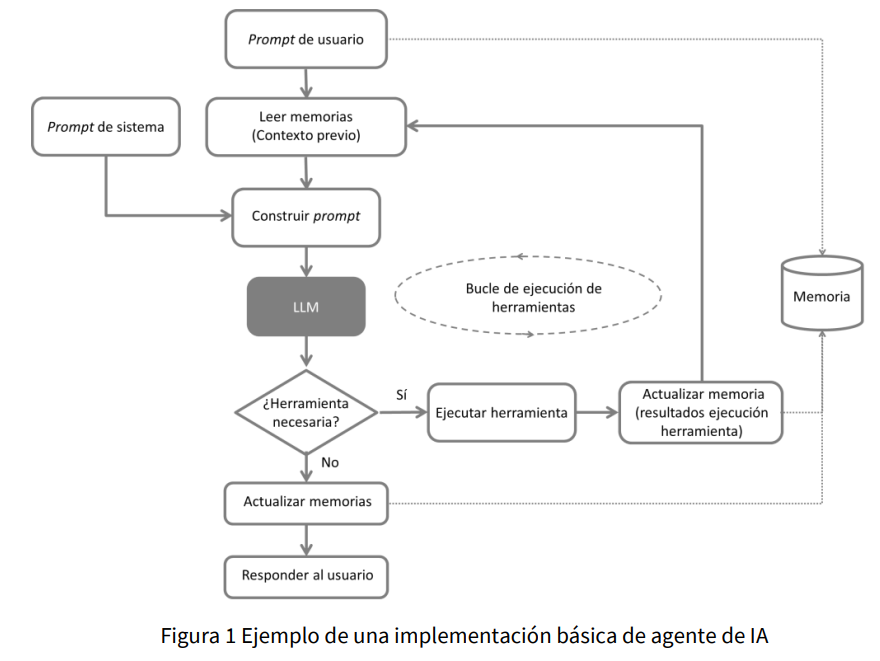
A chatbot responds. An agent takes action. The difference seems small until you see what it means in practice: a customer service chatbot tells you the status of your order; an AI agent detects the delay, checks with the supplier, proposes an alternative solution, drafts an email to the customer, and updates the CRM—all without anyone explicitly asking it to.
AI agents are systems capable of reasoning about a given goal, planning the steps necessary to achieve it, and executing actual actions on connected systems (email, CRM, ERP, databases), coordinate with other specialized agents, and learn from the results to improve the next iteration. Agent-based AI is the paradigm that makes all of this possible: software architectures where multiple autonomous agents collaborate on complex workflows with minimal human supervision. It’s not science fiction; it’s what’s already happening in companies that are one step ahead.
The 2026 Landscape: Who's Winning and in Which Sectors
Gartner believes that In 2026, 15% of routine business decisions will be made directly by an AI agent. McKinsey reports a positive ROI within three to six months for well-executed implementations, and 62% of organizations already have active agents. But not all sectors benefit equally. These are the ones setting the pace now and the ones that will set the pace in 2027.
Health: The Agent Who Never Rests
The healthcare sector is arguably where AI tools have the most immediate and profound impact. The processes are repetitive, the volume of data is immense, and errors have real-world consequences. They are already being used agents for assisted diagnosis, which analyze imaging tests, cross-reference medical records, and generate preliminary reports in minutes, freeing up the specialist to make the final decision.
Also for the follow-up care for patients with chronic conditions, with systems that monitor vital signs, detect deviations, and issue proactive alerts without waiting for the next checkup. And in administrative management: automated triage, appointment scheduling, registration and discharge management, and the generation of clinical documentation.
Looking ahead to 2027, the first clinical agents capable of coordinating across specialties will begin operating in large hospitals, and private clinics and centers will take the lead before the public health system. Of course, all this data must be handled with special care, as it is sensitive personal information: the data protection authorities in the EU They have already imposed 237 penalties on the healthcare sector, totaling approximately 22.8 million euros.
Legal and Compliance: Accuracy Where It Matters Most
«Legal AI» is the industry keyword with the highest search volume in Spain, and it makes sense: law firms and legal departments handle volumes of documentation that no team of people can process as quickly as the market demands.
- An agent can review Review hundreds of contract clauses in minutes, flag inconsistencies, and generate a risk report.
- The case law search, which used to take hours to run on specialized databases, now runs in seconds with accurate results.
- And the regulatory monitoring, the automatic tracking of changes in the BOE, the DOUE, or regional legislation now includes proactive alerts.
In fact, several have emerged AI agents specializing in labor law, tax, and administrative law, provided by attorneys who are well-established in the legal sector.
By 2027, in Spain, the entry into force of the AI regulatory framework Paradoxically, this will accelerate adoption: companies will need agents to help them comply with their own AI regulations.
Finance and Banking: Speed and Accuracy at Scale
The Financial institutions have been investing in automation for years, but agent-based AI represents a qualitative leap: moving from automating isolated tasks to orchestrating entire processes from start to finish. There are already agents dedicated to:
- Fraud Detection in real time, analyzing transaction patterns and blocking suspicious transactions in milliseconds
- Financial Advice tailored, by understanding the client's full context to proactively suggest portfolio adjustments
- Credit Risk Analysis, with evaluations that are faster, more accurate, and less biased than traditional models
- Regulatory Reporting, automatically generating reports for the Bank of Spain, the CNMV, or the ECB with full traceability.
The major banks operating in Spain already equip their account managers with in-house AI to answer questions about banking operations.
Looking ahead to 2027, We will see the first «personal financial advisors» emerge» integrated into mobile apps: not assistants that answer questions, but agents that actively manage users' finances and make investments. And fintech companies will likely get there before traditional banks.
Education: A tutor who adapts to each student
Education is perhaps the sector where the potential impact of AI is more transformative in the long term, and also where institutional adoption is progressing more slowly.
There are already agents from
- Adaptive Tutoring, which identify each student's challenges, adjust the pace, and generate personalized exercises in real time
- Automated Assessment, capable of evaluating writing and reasoning with detailed feedback, beyond a simple test
- Development of instructional materials, creating a complete training module tailored to a specific learner profile in just minutes
- Guidance and Follow-up, monitoring progress and identifying risks of dropout before they occur.
Looking Ahead to 2027, e-learning as we know it (recorded courses with quizzes at the end) will become obsolete in the face of fully adaptive learning experiences. Business schools and vocational training centers will take the lead before universities do.
Marketing and Sales: The Agent Who Never Stops Working
In marketing, AI agents aren't just another tool in the stack—they represent a complete overhaul of how demand is generated, leads are qualified, and deals are closed. They're already being used to
- Real-time lead scoring, analyzing the behavior, source, profile, and context of each lead to automatically prioritize the sales team's pipeline
- Personalization at Scale, with campaigns in which each recipient receives a message tailored specifically to them, rather than a segment-based variation
- Orchestrated Content Creation, where one staff member creates the briefing, another writes the article, another optimizes it for SEO, and another adapts it for social media
- Conversational CRM which is automatically updated based on calls, emails, and meetings.
By 2027, the the first «agent-first» marketing departments»: structures in which the management team defines strategy and provides oversight, while agents carry out the 80% of operational tasks.
Logistics and Operations: The Supply Chain That Runs Itself
Supply chains are complex, dynamic, and unpredictable systems—exactly the kind of environment where AI agents offer the most value. They are already being applied to
- Real-Time Route Optimization, recalculating routes in response to any changes without human intervention
- Predictive Inventory Management, by analyzing demand, seasonality, and context to anticipate needs and avoid stockouts or overstocking
- Automated Quality Control, using computer vision and AI to detect defects on the production line at speeds that no operator can match.
Looking ahead to 2027, logistics will be one of the first sectors to operate using systems fully autonomous multi-agent systems: agents for planning, execution, monitoring, and reporting, coordinated in real time.
Trends for 2027: What's Next
If 2026 is the year when AI agents move from the pilot phase to full-scale deployment, 2027 will be the year when multi-agent architectures become the norm and the first industries undergo real structural transformations.
- Orchestrated multi-agent systems: We will stop talking about «an AI agent» and start talking about «teams of agents.» Research, writing, distribution, and analysis will all work in parallel, coordinated by an orchestrating agent.
- Sovereign AI and vertical models: The competition won't just be about who has the most powerful model, but who has the best-trained model in a specific domain. Specialized models will outperform generalist models in their respective fields.
- Human validation: The debate will no longer be «Should we trust AI?» but rather «For which specific decisions do we need human oversight, and how do we design it?»
- Regulation as a catalyst: In Spain, once the regulatory framework is fully in effect, it will create an environment in which companies need agents to comply with the regulations… regarding agents. A productive paradox.
- AI on physical devices: the convergence of agents from AI and Robotics, IoT and digital twins will bring agent-based AI to the physical world: warehouses, factories, hospitals, and smart buildings.
What This Means for Your Company
The question is no longer whether the AI agents They'll reach your sector. They're already on their way. The question is whether Will your company be one of those leading the transition, or one of those managing it reactively? when there is no other option.
The cost of inaction is invisible in the short term but very real in the medium term: faster, cheaper, and better-informed competitors; teams that can do in hours what currently takes days; processes that don’t make mistakes due to fatigue. And the cost of doing things wrong is also real: Agent-based AI is not plug-and-play; it requires design, implementation, and some changes to business processes.