The global CRM software market reached $128 billion in 2024, after growing by 13.4% for the second consecutive year, according to Gartner figures, and forecasts for 2026 indicate that it will continue to grow at a double-digit rate. And the fastest-growing features aren’t the ones that have been around since the 1990s, but rather those that They help you get to know your customers and build a comprehensive data profile using AI. Even so, many companies still manage their customers using email, Excel, and reports.
CRM platforms with a long history, such as Salesforce, Zoho, and HubSpot, have implemented AI into many of their processes to expand their functionality and customization capabilities. They have a High capability for integration with platforms such as WhatsApp and any type of website.
Although it seems idyllic, these days it's very easy to make common mistakes when it comes to Implement AI in Your Business. That's why we want to tell you what you need to know before equipping your CRM with the most powerful features that artificial intelligence has to offer.
Process Analysis and Mapping
Not all processes need to be rebuilt using AI. In many cases, we have identified clients who have implemented a solution that is too advanced for the capabilities of their sales or logistics teams. Therefore, the first step in any automation effort is thoroughly analyze what is happening.
Below, we explain what process mapping is:
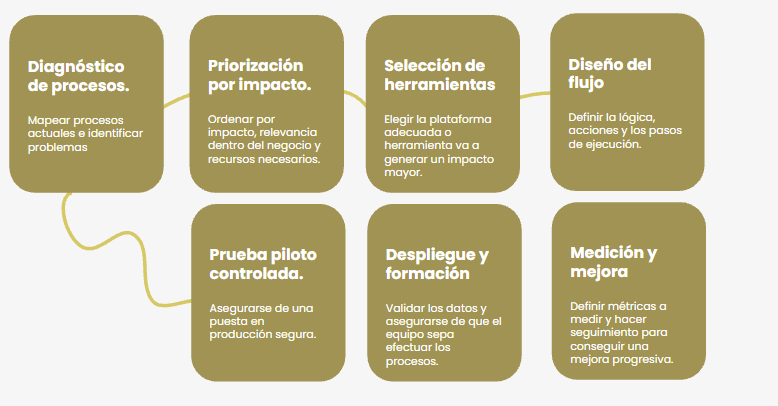
Each step is key, and they are not mutually exclusive. Knowing exactly What do we want to improve, using what tool, with what goals, through what review process, and within what timeframe? It will help build a much more efficient operation.
AI is a layer of automatic improvement, yes. However, there are intermediate tasks that may require human intervention, which is why processes must be broken down from start to finish. Let's take a look at a A very common scenario in B2B companies without a CRM:
A new lead comes in. An installer fills out the form on the website, and the message is sent to info@empresa.com. Whoever checks the inbox that day reads it and forwards it to the sales representative they believe is responsible for that area.
Other leads come in via phone, business cards collected at a trade show, or a sales representative’s personal WhatsApp account. The problem is that there is no single point of entry. Some leads go unanswered, and the information doesn’t reach the person who can follow up on that lead.
Communication is probably the most common bottleneck in businesses. This is where a good CRM and AI can come into play, ensuring that the chances of losing a high-quality lead are virtually nil:
With proper implementation, you can set up a single funnel. The AI reads each message, for example: “I need a quote for 200 m of cable and electrical panels for a warehouse in Burgos; the project is scheduled for November.”, and highlights the key points:
It's an installation project; it requires wiring and electrical panels. The work is in Burgos, and the deadline is urgent.
From there, The CRM could assign the contact to the sales representative in that area, mark it as a priority, and create a task for them to call that same day. In the meantime, the customer receives a personalized response within minutes confirming what they requested and who will be calling them. If no one contacts them within 24 hours, a notification is sent to the person in charge.
These types of actions ensure that a high-quality lead isn't lost due to a lack of response. Every business has a different target audience, of course, but when a customer needs a product or service, we must position ourselves as the primary source of that offering as quickly as possible.
Just as with the entry of a lead, the same applies to other processes within the operations of any company. That is why mapping the processes will help determine the most appropriate improvement for each one, whether or not they use AI.
Workflows
They embody the very essence of automation. With them, you can set up workflows for the different areas and steps of your business. While there are many tools available, such as Connectif o Klaviyo with whom we've worked can also be linked to your CRM.
This is where the processes you analyzed earlier start to make sense. Through workflows, you'll be able to Configure actions, frequency, and decision channels, etc.
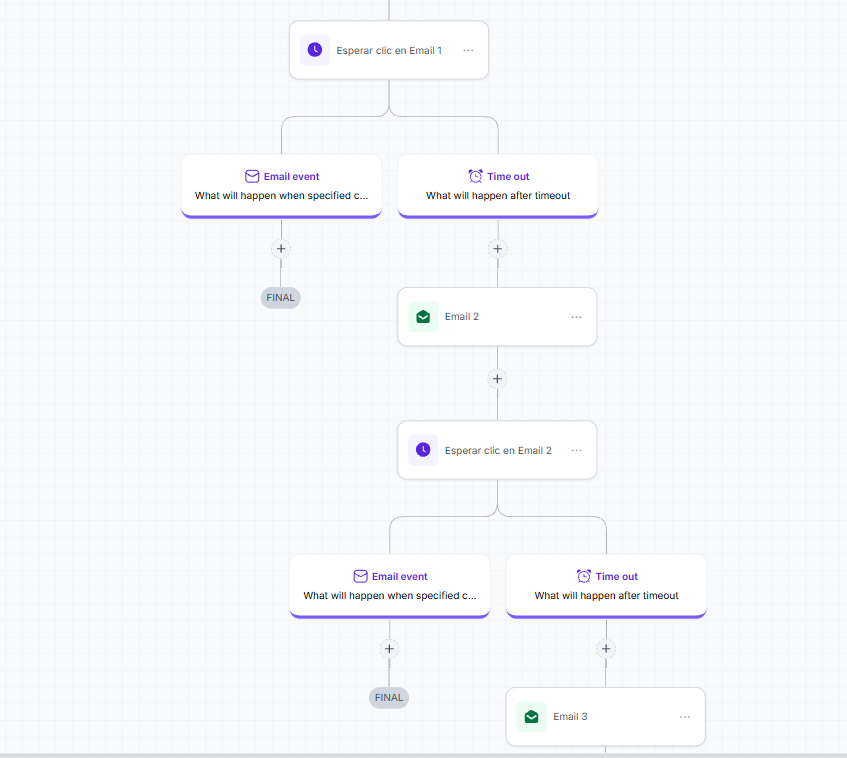
In this image, you can see how this workflow depicts a simple process that begins with a click in an email. The marketing automation It is one of the fastest-growing tools in recent years. At Geotelecom, we have a team of experts in this field and in the implementation of fully customized CRM systems.
Training
Not all digital transformation processes are straightforward. Switching from an Excel spreadsheet that has been used for years to track revenue or from a database to a completely new platform requires a great deal of effort.
Some popular CRM systems don't have a very user-friendly learning curve, or, They need highly skilled people to develop specific modules for your business.
Salesforce, for example, is one of the most widely used CRMs in the world. The “but” is that it can be a bit complex to implement if businesses don’t have specialized development resources, as explained Marketing4ecommerce in its CRM rankings .
To choose a good CRM, we recommend that you consider the following:
- Current Capacity of the Sales Team and what the entire onboarding process is.
- Tools Currently in Use. This is because it will be very helpful to know whether the new system will allow you to migrate your data without losing anything along the way.
- Your website is compatible with that system and if it is, what you need to connect it.
- Which people will actively use it from the CRM.
- Analyze the total cost and not just the monthly license.
- Data Control of users.
- Medium- and Long-Term Support.
The key point is have a team trained in the use of CRM. If a profile is not actively used, there is a risk of workflow failures, which can slow down the entire operation.
If you're unsure which CRM is best for your business and team, contact us to learn more about our solutions.
Cost of Implementing CRM and AI
Implementation Costs may vary drastically depending on the scope. In our experience, this is a necessary expense because, unlike other systems, it supports a large part of the internal operations and processes that directly influence the generation of leads and new business.
Prices typically range from €0 to over €50,000. There are free CRM systems available, although they offer limited customization and have data storage limits. That is why the most common and recommended approach is to use a professional implementation that can also offer you something beyond the platform itself.
At Geotelecom, we offer an additional layer of marketing that will help you reach the audience that’s looking for your services but hasn’t found you yet. Once your entire lead generation system is fine-tuned, our marketing can help you increase the number of high-quality leads.
When it comes to AI, we recommend using a provider that you can connect to your platform, but also everything else you might need for your project. In this regard, companies like Anthropic offer various subscription plans that allow you to both integrate Claude's basic chat feature and work through the API.
How Does AI Work in CRM?
Implementation Using Native Functions
There are several ways to integrate. Many CRMs, such as Zoho, already have built-in features that allow you to: create predefined workflows, generate summaries, compose emails, and score contacts (lead scoring). It's the easiest option to enable, but also the least customizable.
Implementation via API
On the other hand, we have the API connection. This It is perhaps the most flexible and widely used today because it is compatible with virtually any system. The CRM connects to an external system through platforms such as Make, Zapier, or n8n. This provides much greater flexibility for designing custom workflows, but it requires technical configuration.
Use of Agents
Finally, the agents. An AI that chats with customers (on the website or via WhatsApp) or assists the team internally by accessing and updating the CRM. It's the most powerful, but it also requires the most oversight.
The best option will be both the most compatible and the most flexible for performing more customized actions. Remember that it is a very powerful tool, but it requires human supervision to ensure the best results.
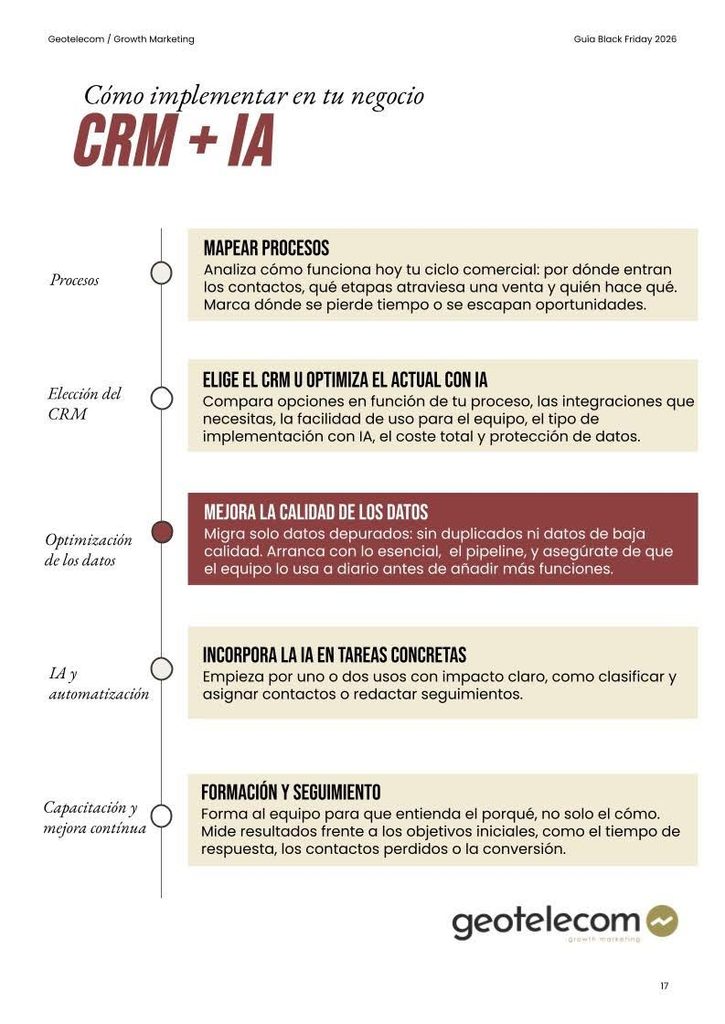
Summary of the Steps
Below is a step-by-step summary of the process you should follow to implement a CRM and add an AI layer to it.
We hope you found this post helpful. At Geotelecom, we have a CRM implementation service, with a GoUp's proprietary solution, which is designed to incorporate layers of marketing automation and ensure that your business is not only well-organized but can also grow from within.