
In a world of constant change and impressive advances, digital marketing was not going to be less. Ever since Philip Kotler, the father of modern marketing, first proposed in the 1990s the four basic rules of marketing to this day, it has rained a lot.
Users have changed their online behavior radically, now they are the ones in control of the buying process and, thus, the 4Ps proposed by Kotler have been replaced by the 4E, focused entirely on the user experience:
- Product is now Experience;
- Price is now Exchange;
- Point of sale is now En all sites;
- Promotion is now Emotion.
And in this agitated context, the lead nurturing as an essential part of today's digital marketing strategies.
What is Lead Nurturing?
If we consider the “lead” as a contact that has visited the website and has given us his or her data (email), the lead nurturing could be translated as the nutrition of leads,which basically consists of, like Lazarillo, nourish, nurture and accompany the user during the purchase process. This comprises the period from being an unknown user to becoming a lead, make the first purchase and become a loyal customer, thus building lasting relationships with users and/or customers, based on actions such as informing, educating, involving, validating, converting, retaining, building loyalty, renewing and an incredible etcetera.
Taking into account the entire purchasing process as a cycle, the lead nurturing could be applied at any of the following stages, The process starts with the acquisition of leads, passing through the generation of interest that ends in conversion and ending with the loyalty of this new customer, as well as the retention or recapture of the most forgetful ones.
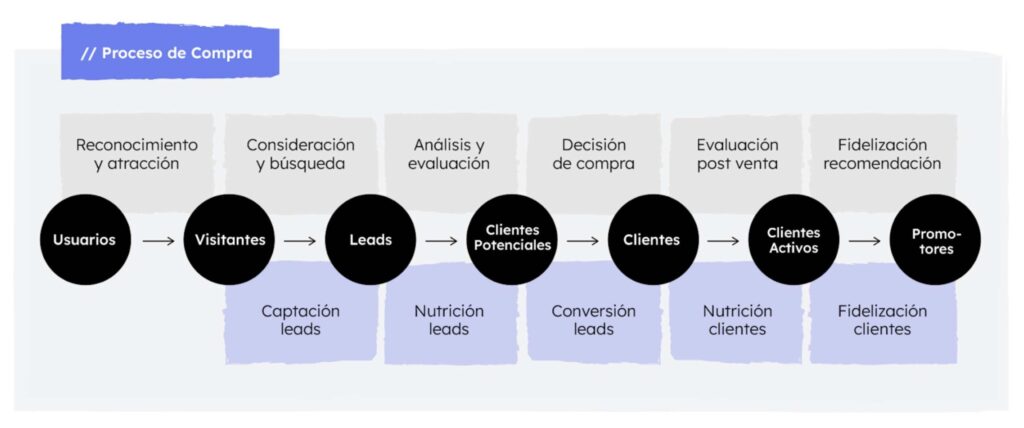
Given this situation and the importance of implementing the lead nurturing within the digital marketing strategies of any company, is essential to the Marketing Automation, to enhance, streamline, improve and automate all these processes.
Through flows of work automated adapted to the objectives of each of the purchase phases, we will be able to create a system that not only offers the right content to the right user at the right time, but also obtain data and analyze user responses to our marketing actions. In this way, we adapt as much as possible to our specific target audience within our company's sector.
Importance of the data first in the strategies of lead nurturing
As we have just discussed, the main function of the lead nurturing is the creation of workflows automated systems that allow user segmentation and content personalization.
However, before any action is taken, it is imperative to first analyze the data, and this is where the data first: website visits, newsletter subscriptions, abandoned carts, types of purchases, products visited for recommendations, etc.
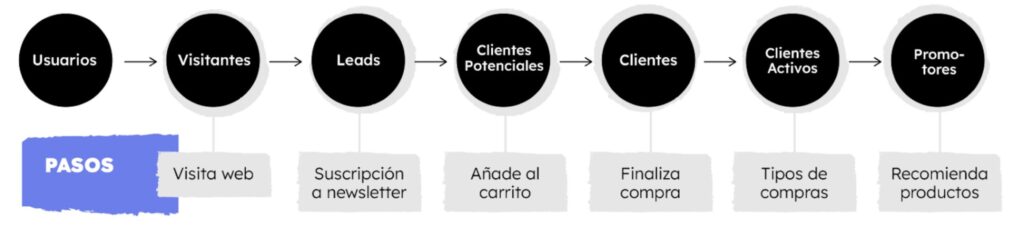
Through this data we achieve the goal of any marketing automation campaign:
Strategies and workflows
Depending on the stage in which the user is, a specific strategy will be applied, so that we can group the strategies as follows three main stages:
- Lead generation and acquisition.
- Pre-sale stage.
- Post-sale stage.
Let's look at each one in a little more detail:
Lead generation and acquisition
Stage in which users visit our website for the first time and we begin to study their behavior in order to impact them. The objective of to obtain your data by different meanscontact forms, landing pages, notifications push, pop-ups, CTAs...
Pre-sale stage
Stage of purchase decision, from the time it becomes lead (i.e., we manage to obtain the first contact data, such as email, and we can begin to personalized impact) until you make your first purchase.
Post-sale stage
Loyalty stage. After the first purchase is made, a solid and valuable relationship is built that will lead to become a loyal customer and make more purchases, as well as recommending us to other users who generate more sales for us.
Case study 1: generation and collection of leads
We have a case of a customer in which, after the analysis of registrations and cancellations to the newsletter, at the end of the month we have more numbers of unsubscribers than new subscribers.
In view of this, we have to try to reduce the number of unsubscribes while increasing the number of subscribers. How do we do this? Giving the user options to choose their preferences regarding the sending of notifications within the subscription form.
Thus, based on your choice, you will be added to specific segments that will then be used in the scheduling of shipments and the creation of strategies:
Dynamic segment plus: activities of registration and deregistration to the newsletter.
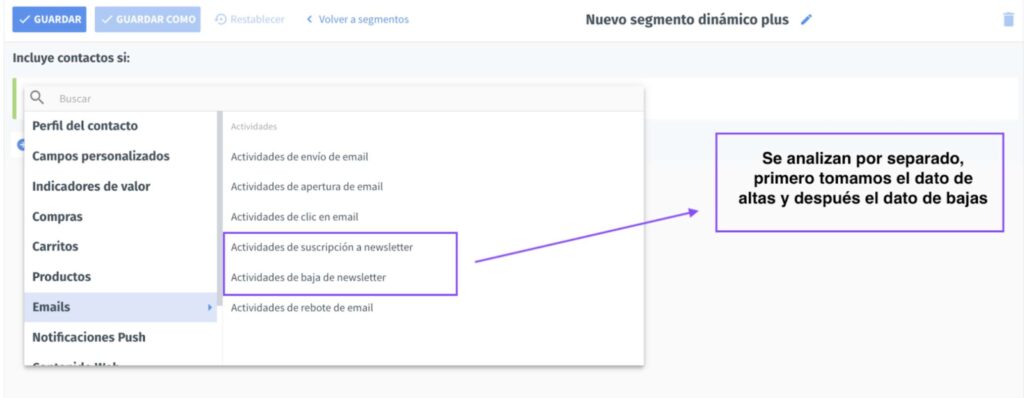
Dashboard: purchases - analysis of purchasers by subscription status to newsletter.
Workflow 1: strategy with subscription form to newsletter + options for sending notifications
Subscription form to newsletter + option to choose the frequency of notifications when filling in the form. In addition to adding the usual name and email fields to the typical subscription form to newsletter, In this way, we add an additional field where we give the user the option to choose the frequency of sending. In this way we not only give preference to the user's needs, but we also reduce the rate of newsletter.
Workflow 2: subscription form strategy to newsletter with alert for stock available
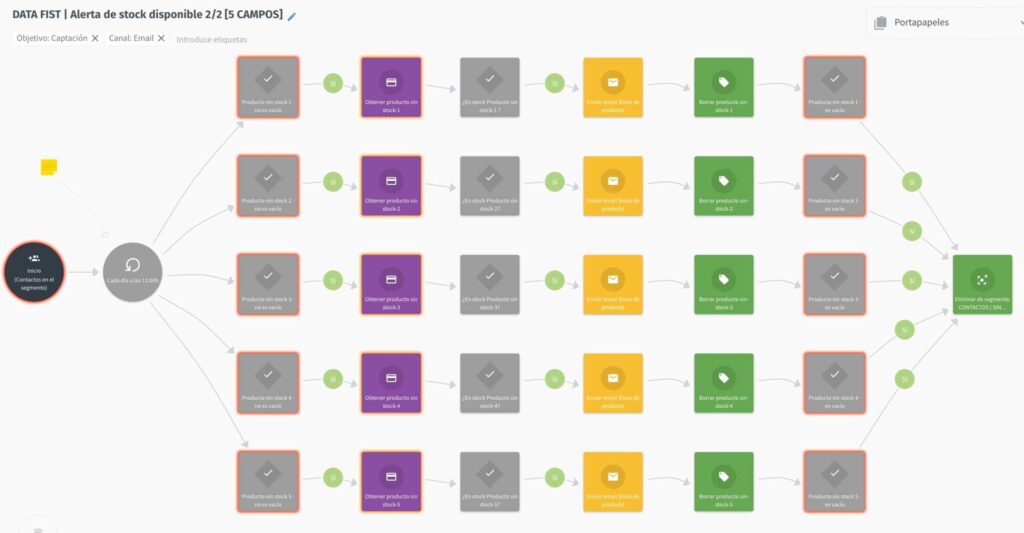
Email sent after subscription to the stock availability alert form. The communication via email of out-of-stock product availability is one of the most important basic options of any CMS, such as Prestashop. However, we can customize it even more, collecting data on the most demanded products through a complex workflow via Connectif as follows:
- We show a in-line on the product card (CTA) for them to click if they want to be notified when the product is back in stock. After clicking a pop-up with a form that, in addition to sending you information when the product becomes available, involves subscribing to the newsletter (for all those who have not yet subscribed). This helps us to increase the number of subscriptions substantially.
- Once the form we will again send you a pop-up thanking you for your subscription and reminding you that we will notify you when the product is available again. At the same time, you will receive a welcome email to the newsletter and will be subscribed to the rest of the notifications or newsletters subsequent.
In the example shown, five available fields are proposed for each user, giving them the option to fill in the stock availability notice form for a maximum of five different products. This number will depend on each ecommerce and the user's behavior, which may be more or less than five.
Case study 2: After-sales stage
One of the latest and most advanced tools added to Connectif has been the segmentation of users by means of the RFM analysis.
This option classifies the users who have already purchased based on recurrence, frequency and recency of purchase, resulting in eleven different segments.
However, it may turn out that some of these segments have a low number of contacts within them, with the help of Data First, we can group these 11 segments into three main groups for marketing automation strategies: HIGH RFM, MEDIUM RFM and LOW RFM:
- RFM HIGHchampions + loyal customers
- RFM MEDIUMPotentially loyal + new customers + promising + needing attention
- RFM LOWabout to fall asleep + at risk + cannot be lost + hibernating.
The “lost” RFM segment has been excluded from this classification in order to apply specific purchase reactivation strategies to them. In addition, for the creation of these segments for sending notifications, we have added the condition “state subscription = subscriber”.”.
Dashboard data: Purchasing - analysis of buyers by RFM segment.
Dynamic segment plus: creation of RFM segments + subscribed to newsletter
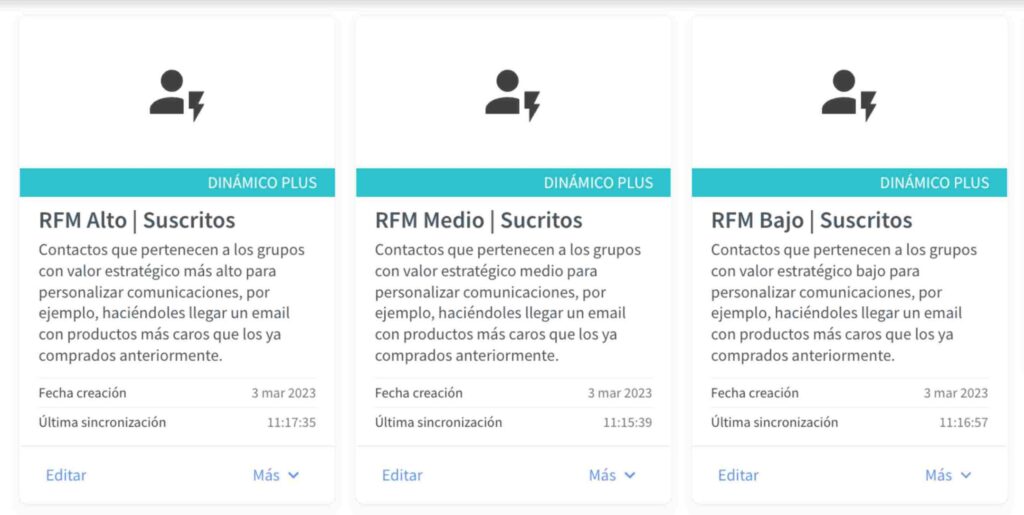
Workflow 1: after-sales strategies according to high, medium or low RFM segments
After-sales strategies via email by RFM segment. Once the first purchase is made, it becomes part of the RFM analysis system. In this way we can focus our strategies on either recurrence, frequency or monetary value.
In this case, depending on the RFM segment to which you belong, you are sent specific content based on your previous purchases:
- RFM HIGH - upselling (higher priced products)
- RFM MEDIUM - crosselling (complementary products)
- RFM LOW - best seller (the best sellers of the last month/week)
By way of summary, the lead nurturing is essential in any digital marketing campaign and will take different forms depending on the type of company, ecommerce or sector to which it belongs and based on the stage of the buying process in which the user is. And to achieve it, Marketing Automation is the way and Connectif is the perfect tool.
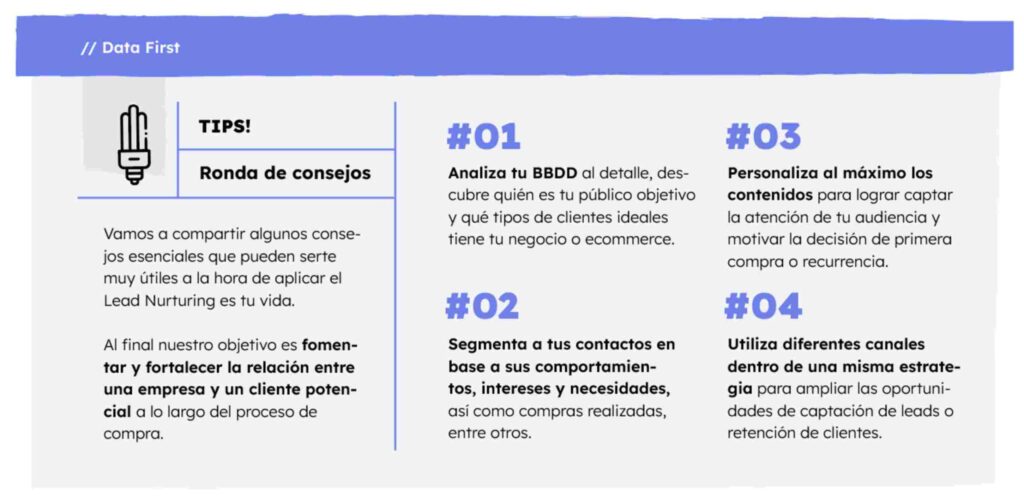
Having said all this, we do not want to say goodbye to this post without making some small recommendations and essential tips:
Ready to start using the lead nurturing in your business? Contact us now and find out how you can benefit from lead nurturing in your strategy using marketing automation.


