If you run an online store and your Google campaigns If they aren't really taking off, the problem probably isn't the budget or the targeting. It's the data you're feeding into the algorithms.
The product feed is today the most critical part of any paid media strategy. But also the most neglected.
What is the product feed, and why does it change everything?
Your e-commerce feed is, basically, the file that tells platforms like Google, Meta, TikTok, or Amazon What are you selling, what is it called, how much does it cost, and who is it for?. So far, nothing new.
The problem is that most stores treat it as a mere formality: They export the catalog exactly as it appears on their platform (Shopify, PrestaShop, WooCommerce…) and upload it without making any changes.
And with today's algorithms, that's a very costly mistake.
Performance Max campaigns on Google and Advantage+ campaigns on Meta no longer use manual targeting. The AI on these platforms decides who to show each product to It relies almost exclusively on the quality of the data it receives. If you give it poor data, it makes bad decisions. If you give it rich, structured data, it can do some very powerful things.
The quality of the feed determines the quality of the campaigns. It's that simple.
The Most Common Mistakes When Managing an E-commerce Feed
At Geotelecom, we work with catalogs from dozens of clients, and the problems we encounter are constantly recurring:
- Generic titles. «Basic T-shirt» doesn't mean anything to the algorithm. It doesn't know if it's for women, made of cotton, what size it is, or what brand it is. It can't match it properly with any search or any user.
- Incorrectly mapped categories. "Product Type" is one of the attributes that has the greatest impact on ad distribution, and most stores leave it blank or fill it out incorrectly.
- Incomplete attributes. Size, color, material, shipping time… Every missing attribute is context that you’re taking away from the algorithm.
- No distinction by channel. The title that works on Google Shopping isn't the same as the one that works on Meta or Amazon. A single feed for all channels is usually a mediocre feed for all of them.
- No profitability data available. Investing the same budget in products with a 5% margin and in products with a 40% margin is one of the most costly mistakes made in e-commerce.
How We Optimize the Product Feed at Geotelecom
To manage all of this, we work with LightHouse Feed (LHF), a a platform specializing in feed optimization and distribution which allows us to go far beyond what any standard export feature can do.
Here's what we do on a day-to-day basis with our clients:
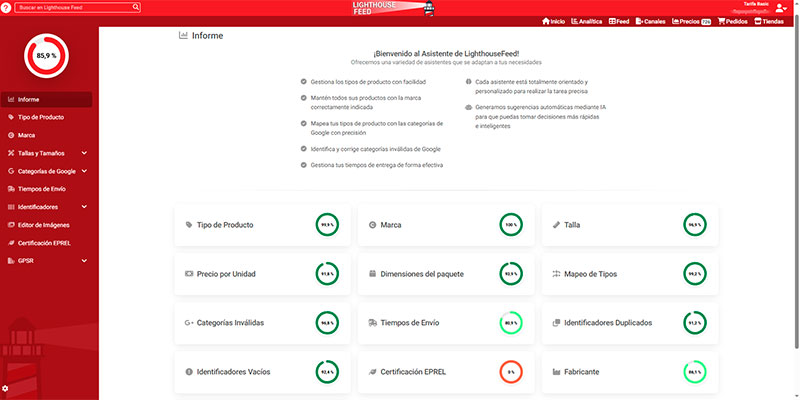
Mapping and Automation of the Product Type
Correctly mapping product categories in bulk using logical rules is one of the most tedious tasks in feed management. LightHouse Feed automates it in a matter of seconds, ensuring that each product is correctly categorized across all channels.
Massive Title Enrichment
Instead of relying on the store's native titles, we built a an automated structure that combines the most relevant attributes For each channel:
[Brand] + [Key Feature] + [Product] + [Size/Color]
This is configured once using rules and is automatically applied to the entire catalog, even if it contains thousands of SKUs. The result is a feed where each product has the most informative title possible for the algorithm that will distribute it.
Dynamic lead-ins for promotions
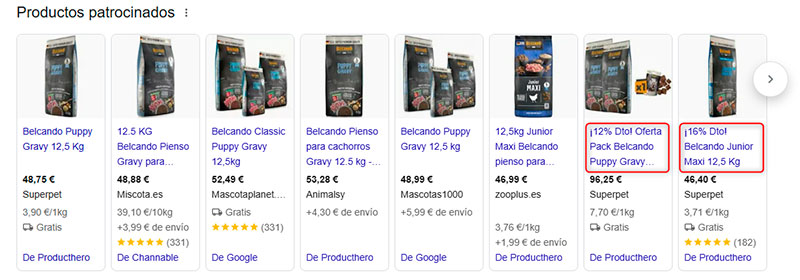
During sales events, we insert dynamic text at the beginning of the title («20% DTO.,» «Free Shipping,» etc.) to improve ad CTR without having to make any manual changes. You set it up once, and it automatically applies to all products that meet the condition.
Segmentation Based on Actual Profitability
One of LightHouse Feed's strengths It's its ability to cross-reference your catalog data with the reality of your e-commerce business.

The tool includes shipping costs, fees, and other associated expenses to calculate the actual margin and sales volume for each product.
Thanks to this, at Geotelecom we can design advanced strategies by creating custom and automated tags for your catalog:
Profitability Tags and Catalog Cleanup
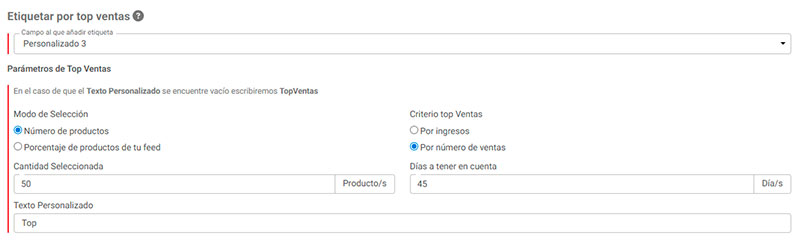
LHF allows you to create custom and automated labels based on each product's actual performance. This enables us to group and Prioritize items with the highest profit margins in standalone campaigns or the best-sellers during a specific period, allocating them a larger budget and more aggressive bids.

And vice versa: instantly filter out and exclude products you're not interested in Advertise on specific channels, whether based on profit margin, inventory, or seasonality. You decide what to sell and where.
Full traceability with automatic UTMs
LHF automatically injects UTM tracking parameters into all products in the feed. That means that in GA4 or any analytics tool We can determine exactly which channel, which campaign, and which specific product generated each conversion.
Marketplace Management: Beyond Google and Meta
In addition to the usual advertising channels, LightHouse Feed allows us to manage our presence on marketplaces like Amazon, with the same level of control.
Each marketplace It has its own formatting rules, required attributes, and technical requirements. Managing it manually for a medium-sized catalog is impractical. With LHF, we automate:
- The title construction tailored to each marketplace's algorithm
- The real-time price updates in accordance with the client's business rules
- The synchronization Centralized Order and Inventory Management
The result is better organic ranking within the marketplace and fewer returns, because the user understands exactly what they're buying before clicking.
Why is this more important now than ever?
In an environment where campaigns are becoming increasingly automated, the product feed has become the only lever over which you truly have complete control. You can't control Google's algorithm or how Meta distributes your ads. But you can You can control the quality of the data you provide them. And that is precisely the difference between a catalog that works for you and one that simply exists.
At Geotelecom we do Feed audits for e-commerce clients, identifying opportunities for improvement. If you're not sure whether your catalog is properly structured for the channels where you advertise, we can review it together with no obligation.