An SEO report provides insight into how a website's organic search rankings are evolving, but simply collecting data doesn't necessarily mean you understand what's happening. Clicks, impressions, traffic, rankings, visibility, authority, or conversions can help us evaluate a strategy, as long as we know how to put each metric into context.
In fact, today it's relatively easy to gather much of this data in one place. Tools such as Google Search Console, Google Analytics 4, or third-party SEO platforms allow you to access a vast amount of information and Looker Studio makes it easy to create dashboards that update periodically.
The real work begins afterward: interpreting that data, connecting the dots, and understanding what is causing the changes.
That's why a good SEO report It shouldn't just tell us how much we've grown or declined compared to the previous month. It should also help us understand Why did this happen, and what can we do from now on?.
What metrics should an SEO report include?
There is no one-size-fits-all template for all projects. The metrics that matter for an e-commerce business won't be exactly the same as those for a company whose goal is to generate leads.
Even so, there are several indicators that help us gain a fairly comprehensive view of how a strategy is performing.
Organic traffic
It's one of the first pieces of data we tend to look at, but focusing solely on the total number provides little insight.
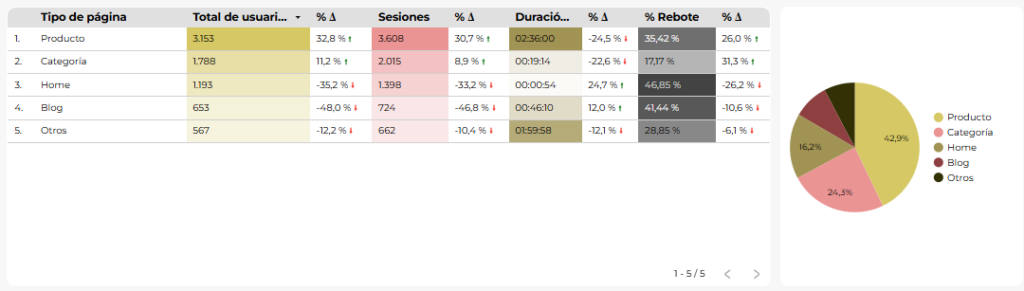
In addition to analyzing its evolution, it is interesting to know Which pages are generating that traffic, and what happens after the user arrives at the website?.
In an e-commerce site, for example, we can Separate traffic that comes directly to categories or product pages from traffic that comes through the blog or an informational guide.
And we can take it a step further. If a guide is generating thousands of visits, we can analyze what those users do next: which pages they visit, whether they navigate to a product category, whether they view products, or whether they end up making a purchase.
This provides a much better understanding of the role each type of content plays within the strategy.
Clicks, Impressions, and CTR
Google Search Console allows us to analyze How our website appears in search results and analyze metrics such as clicks, impressions, and CTR.
But, again, we have to connect them.
An increase in impressions may indicate that we're appearing in more search results, but if clicks aren't following the same trend, we should investigate what's happening.
We may be gaining visibility in positions that are still too low, appearing for new search queries, having a low CTR for certain searches, or even seeing changes on the results page itself.
That is why it is interesting to analyze this data both at a general level and by query, URL, device, or country, depending on the project.
Positions and Keywords
Rankings remain useful for tracking the performance of certain strategic searches, especially when we monitor keywords directly related to the business's products or services.
However, nor should they be interpreted in isolation.
Moving from position 8 to position 5 may be significant, but its impact will depend on search volume, user intent, the characteristics of the SERP, and, above all, whether that improvement ultimately generates traffic and business.
Also It is best to separate brand searches from generic searches. Growth driven primarily by users who are already familiar with the company tells a different story than an increase in visibility among users who are not yet familiar with the brand.
SEO Visibility
SEO tools allow you to calculate visibility metrics that help you track a domain's performance in search results.
It is a particularly useful metric for identifying trends, comparing time periods, or analyzing how we are performing relative to our competitors.
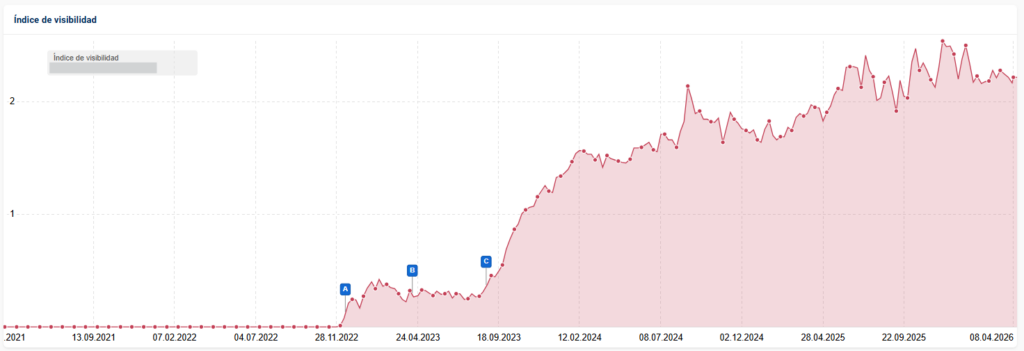
But Greater visibility does not automatically translate to more traffic or more business.
Furthermore, when we look at the trends over the past three, six, or twelve months, we have to take into account what has happened in connection with the project. Demand may have changed, campaigns may have been run on other channels, there may be strong seasonality, or Google may have modified its search systems.
That's why Visibility works especially well when analyzed alongside other metrics and within the context of the business.
Domain Authority and Links
Changes in domain authority can also help us understand how the project is growing and, in particular, the strength of its backlink profile.
To analyze it, we can use metrics such as the Ahrefs Domain Rating (DR) or other similar indicators. The DR measures the relative strength of a domain's backlink profile on a scale of 0 to 100, taking into account factors such as the quantity and quality of the domains linking to it.
Of course, we should view this as a guideline rather than a standalone goal. Google does not use Ahrefs' DR as a ranking factor, although links and the authority they convey are indeed relevant to SEO.
It’s also important to understand where this growth comes from. The growth in your backlink profile doesn’t necessarily stem solely from SEO efforts: a press mention, a partnership, a public relations campaign, or increased brand awareness can all generate new mentions and links.
That is why, in addition to observing whether our authority increases or decreases, it is worth analyzing Which new domains are linking to us, which pages are receiving those links, and what their quality and relevance are.
Conversions, Leads, and Revenue
We can increase traffic and improve rankings and still not be getting any closer to our business goals. That's why an SEO report should, whenever possible, include metrics related to conversions.
In an e-commerce business, we can analyze purchases, revenue, or products sold through organic channels. In a service-based business, we can track submitted forms, calls, quote requests, or other relevant actions.
But Not every page has to generate a direct conversion to add value to SEO and the business.. A guide can capture traffic during the initial search phase and then direct the user to a category, a product, or a service. That's why it's also important to analyze the role each piece of content plays in the user journey.
For example, we can analyze which pages users visit after arriving via a guide and see if that informational traffic eventually leads them to more commercial areas of the website.
A dashboard is not an SEO report
With tools like Data Studio, we can centralize data from different sources and build dashboards that update themselves almost automatically.
And this is very useful. At a glance, we can see trends in organic traffic, Search Console clicks, conversions, the devices used, and the pages that are growing.
We can even create much more specific views. For example, Determine how much traffic the transactional portion of an e-commerce site receives and how much goes to the blog, or analyze which users initially arrived via a guide and which pages they visited afterward.
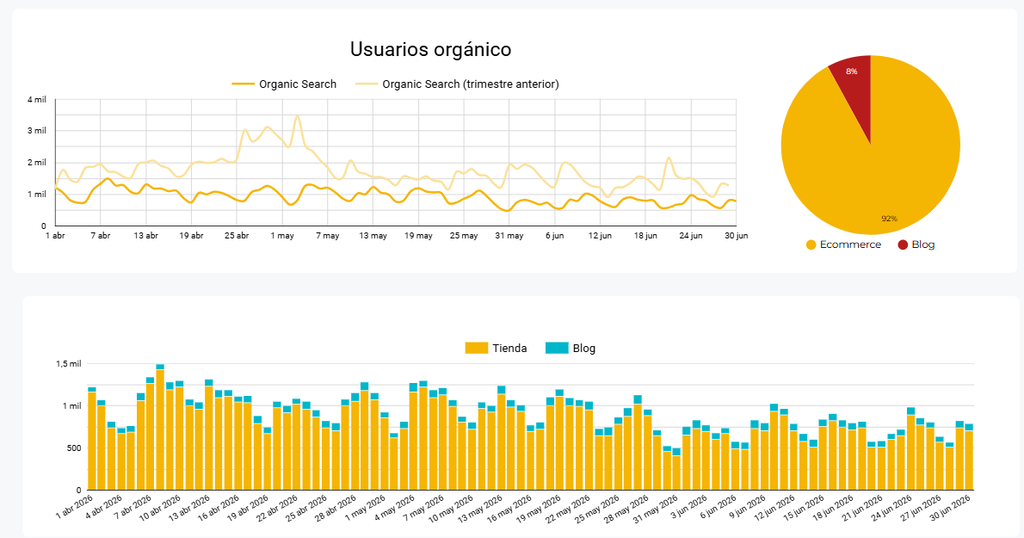
But a dashboard is still a representation of data.
If we see that organic traffic has dropped by 20 %, the dashboard tells us What happened?. An SEO analysis should aim to explain why it happened.
Has the entire domain been affected, or just certain URLs? Have we lost rankings? Has demand decreased? Does the decline mainly affect informational searches? Has the competition changed? Does this coincide with a Google update?
That's exactly where the difference lies:
The data show what happened. The analysis attempts to explain why. And the strategy determines what we do next.
Does an SEO report still make sense with the advent of AI?
Artificial intelligence has made data processing much easier. We can work with large Search Console exports, group queries, compare time periods, or identify patterns much faster than we could a few years ago.
But that doesn't make the analysis any less necessary. In many cases, the exact opposite is true.
Search itself is changing. Google is integrating AI-powered experiences, and data from these surfaces can now be included in Search Console’s overall metrics. This makes interpreting performance solely through the traditional framework of keywords, rankings, and clicks increasingly limiting.
On our Report on the Impact of AI on SEO We analyzed more than 40 projects across various industries cross-referencing metrics such as CTR, average position, traffic, clicks, and impressions to understand how searches and the traditional funnel are changing.
AI can also help us to detect that a category has lost traffic or that a group of queries is behaving differently. However, correctly interpreting that change requires understanding what has happened in the project.
Certain products may be out of stock. A brand campaign may have ended, a transition may have taken place, demand may have shifted, or new competitors may have emerged.
AI can dramatically reduce the time it takes to process information. Professional value increasingly lies in knowing which data points to correlate, what questions to ask, and how to turn the answers into decisions.
How can you tell if an SEO report is really good?
A report full of charts may seem comprehensive, yet offer very little insight.
There's a simple way to see how useful it is: Once you're done watching it, do you have a better understanding of what's going on with the project?
You shouldn't just point out that clicks have increased by 15 % or that we've moved up a few spots. You should provide context: where that growth has occurred, what might explain it, how it affects the project's goals, and what opportunities arise from that data.
Also should reflect the work that has been done. Technical changes, content optimizations, internal linking improvements, new pages, actions related to authority, or any other relevant measures must be able to be linked to the project's progress at a later date.
And you should avoid looking for an SEO explanation for absolutely everything. Sometimes a drop is due to seasonality. Other times, an increase is the result of a branding campaign. Recognizing when a change cannot be directly attributed to SEO is also part of a good analysis.
I have my SEO report—now what?
This is probably the most important question.
Let's imagine that a category has lost 30 % clicks over the past few months. Knowing this is helpful, but it still doesn't tell us what we should do.
First, we'll have to investigate.
If impressions have dropped, there may be a shift in demand or a loss of coverage for certain searches. If impressions remain steady but the CTR drops, we should analyze search positions and results. If we’ve lost rankings, we’ll need to investigate which URLs and search queries are behind that loss and what has changed compared to our competitors.
In other cases The problem may be related to content, internal linking, site architecture, crawling, indexing, or technical issues.
That is why the report should be the starting point for making decisions, not the end of the process.
When the data reveals issues we can't explain or we need to review the project in greater depth, a SEO audit can help us identify what is limiting its growth. And when we need to decide which actions to prioritize and how to carry them out, that's where the work of SEO consulting.
Ultimately, the goal of measuring isn't to have more charts. It's to have enough information to know where we are, why we're there, and what the next step should be.