
On March 3, at the iconic Palace of the Dukes of Pastrana in Madrid, more than 100 representatives from agencies and clients gathered at the new workshop organized by Google on Smart Bidding. This was likely the last event organized by the company for a while, as Google has canceled its upcoming international events due to the COVID-19 and has even banned its employees from traveling until further notice.
As a novelty in this type of event, we separated the attendees into two groups in order to provide better quality training according to the profile of the website: attracting leads o e-commerce. My colleague Cristina de la Peña was our representative in the recruitment group of leads, while I went along with our friend Soledad from the website Old Town to Room 2. Just as we expected, there were no major developments or announcements.
However, we did cover some interesting aspects related to successfully implementing Google's automated bidding strategies.
Here are the highlights of each of the sessions:
Room 1: lead generation
During the first part of the morning, the content of the lectures focused mainly on how to improve the quality of leads obtained through our campaigns. For its part, Google is constantly working to improve its algorithm, which allows it to more effectively detect users’ intent, all with the goal of obtaining more number of leads and of more quality.
They could not pass up the opportunity (and even less so in the case of leads) to emphasize the importance of the configuration of the conversions offline, The missing leg of the system for Google's algorithms to work optimally. The key to this lies in the capture of the gclid and subsequent follow-up offline through the user's e-mail address or telephone number. The idea has tremendous potential, It allows us to feed the system with extremely high-quality information. But as we suspected (and our friends at Google later confirmed), the technical and legal requirements are complex, and it also requires a great deal of cooperation and willingness on the part of the client.
Finally, here's a preview of the main developments for 2019 and 2020:
- Improvement in the quantity and quality of the signals that feed the algorithm.
- Improvements in the operation of the algorithms of smart bidding (In theory, for gradual changes of more than 3 days, it is no longer necessary to make any adjustments to these changes).
- More functions enabled at MCC level.
- Improvements in the bidding simulators.
Room 2: e-commerce
Google's event also left us with a lot of news on its part of e-commerce. Among the main topics addressed during the day, he highlighted an increasingly widespread structure in the Google Ads platform. Hagakure, This is how Google has coined the new formula to automate your campaigns in an efficient and simplified way. What exactly does this new structure consist of?
Well, the main objective is to structure our marketing campaigns in order to Search to enhance the Smart Bidding. As the platform gains more features, our campaigns become more complex, which can make managing them quite tedious. To address this issue, Google’s algorithm is constantly evolving and is now capable of analyzing millions of data points in seconds.
But what does Google's algorithm need to be efficient? From this question arises the new Google Ads structure; Hagakure simplifies the campaign structure to group data and give more freedom to Google's algorithm.
When is it recommended to switch to the Hagakure campaign structure? When we are bidding on the same category, brand, or product across multiple campaigns, and these campaigns differ only in one of the following ways:
- Keyword matching: when our campaigns differ only in match type, but we bid on the same keyword.
- Devices: If we have two campaigns bidding on the same brand, one for desktop and one for mobile.
- Hearings: If we have several campaigns in the same category targeting different types of audiences (affinity, intent, remarketing, etc.)
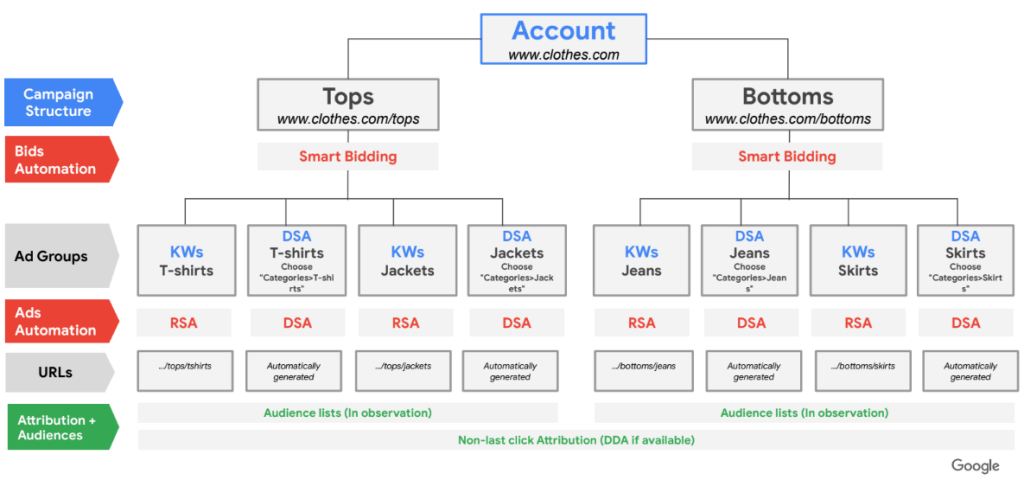
Thus, Hagakura tries to avoid a hyper-segmented structure that prevents the algorithm from working. and proposes combining several ad groups into a single campaign attacking different categories and include a group of dynamic ads (DSA) to attack those categories whose low traffic prevents the implementation of automatic strategies. In this case, we will have to work with refusals to prevent the different groups from competing with each other.
However, not all campaigns are suitable for this strategy, since it requires a minimum volume of impressions per ad group (about 3k impressions per week) in order to use automated bidding effectively. Therefore, it is recommended that you do not set a budget limit so that your campaigns have sufficient data, and that you use broad and modified broad match to capture as wide a variety of user search terms as possible.
That wraps up the latest news from the world of AdWords, brought to you by our friends at Google. We don’t want to say goodbye without congratulating the team at Catering Vilaplana for their excellent organization and the high quality of their catering service. It’s a pleasure to work like this, even on a busy day ;)!


