Until recently, when we talked about organic visibility, we almost always ended up looking at the same metrics: rankings, impressions, clicks, traffic… Today, all of that is still important, but there’s a new question that deserves our attention: What happens when someone asks an AI about our industry, our products, or a need that our business can address?
Because appear in a response generated by artificial intelligence It can mean very different things.
An AI can use an article from your website as a source. It may mention your company because it found it to be related to a topic. Or it may go a step further and recommend your brand when someone asks where to buy a product or which company to choose.
At Geotelecom, we've been working on the SEO for AI within our projects, and we wanted to see what was happening beyond the theory. So we did something quite simple: we asked questions, repeated the searches, changed the intent, and compared the results.
We conducted the tests in October 2026 with Google (AI-generated view), ChatGPT, and Claude, regarding real projects we manage. The responses from these systems change frequently, so it’s best to read what follows as a snapshot of that moment. Even so, the results have helped us confirm something important: simply talking about «ranking in AI» falls short.
What is the difference between a citation and a recommendation in AI?
A citation is when an AI Use a page from your website as a source To craft your response: Your content provides information. A recommendation is when AI Include your brand among the options it suggests To the user: Your company is part of the solution. And between the two of you, there is a middle ground: the mention, in which AI mentions the brand without linking to its website or explicitly recommending it.
This is easier to understand with an example. Let's start with a information search: «How much money do I need to start investing in gold?» If the answer is based on an article by a company that specializes in precious metals to explain how much capital is needed, we have a citation: The website is serving as a source.
Now let's change the query to a business search: «What are the best places to buy gold online in Spain?» If that same company appears among the suggested options, we have a recommendation. It no longer just provides information: the brand itself is part of the solution to a business need.
The difference matters. A quote can reinforce our authority on a topic, while a recommendation brings us much closer to a purchasing decision. And one does not necessarily imply the other.
When does an AI use a website as a source?
Based on what we've observed, an AI tends to use a website as a source when you have a page that specifically answers the question being asked. It's not enough to just talk about the topic in general: content created to address a specific question works best.
We cannot say that this always happens or that there is a direct cause-and-effect relationship. Generative systems They do not provide a set formula that ensures which URLs they will select. But we have noticed a pattern, and we verified it in one of our projects.
This is a precious metals sector project. We've been working on his blog and building his brand authority for years, using an SEO strategy that includes link building. At first, we needed to build a content foundation around relatively broad topics within the industry. Over time, we've been able to go into much greater depth and address specific questions: how much money you need to start investing, the differences between bullion and collectible coins, the liquidity of certain coins, and when it might be a good idea to sell gold.
We decided to see what would happen if we entered some of those questions directly into AI-powered search engines.
From a Specific Search to a Source
We searched Google: «How much money do I need to start investing in gold?»
The AI-generated image used this as one of its sources the specific article that we had worked on that issue.
We're still testing:
«Is it better to buy gold bars or gold coins as an investment?»
Another URL for the project among the sources.
«Which gold coins are easiest to sell in Europe?»
It appears again blog content.
«What's the difference between bullion and numismatics?»
AI once again turns to a page that specifically addresses that question.
In the four clinics we tested, the response cited a URL from the project's blog among its sources.
What we can verify, however, is the result: various pieces of content created to answer very specific questions are being used as sources when users ask exactly those questions.
And this reinforces something we've been working on for some time in SEO: It's not all about chasing the keyword with the highest search volume. A specific question can bring us much closer to a real need.
What makes an AI recommend a brand?
We haven't identified a single factor. In our tests, the factor that had the greatest impact on the result was the purpose of the consultation, the AI engine who answered and the sources on which the response was based, whether internal or external.
We saw this when we raised questions with a clear commercial intent on two e-commerce sites in very different industries: one specializing in precious metals and the other in the pet industry.
A brand doesn't always appear
The pet industry project The blog is a leading authority on the subject: we cover everything from dog breeds and recommendations for dog food lines to the latest industry news. In addition, we optimize the SEO for product pages—with frequently asked questions and key information clearly highlighted—and ensure effective interlinking between content, categories, and products.
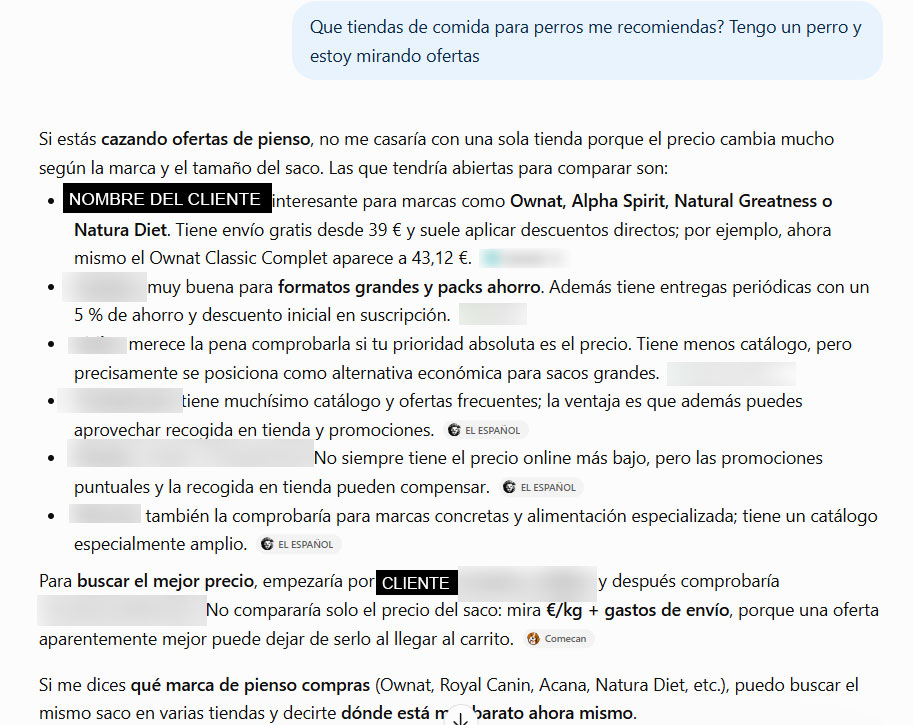
Even with all that work behind us, we did six general inquiries related to buying food and dog food.
The company appeared in four. The AI included it in several searches for recommended stores, the best stores, or where to buy pet food online, and even in some focused on deals, but not in all of them: The result changed when the way the question was asked was modified.
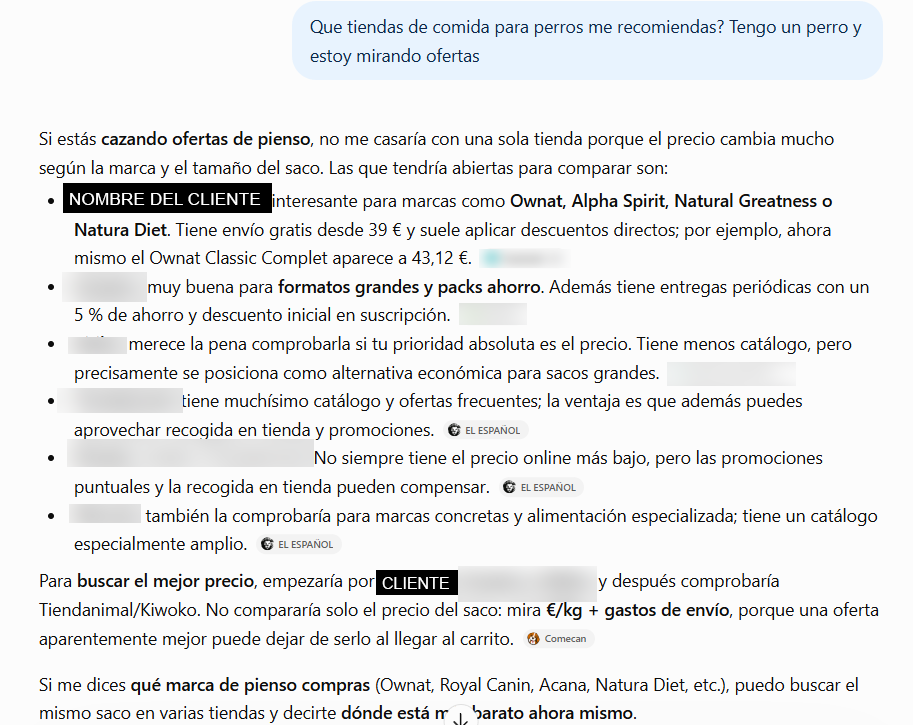
Also take a look at the sources cited for each recommendation: AI doesn't rely solely on the store's website.
We then conducted the test using different brands of pet food. It only appeared when I asked about one of them.
This significantly changes the question we should be asking ourselves. Instead of, «Does my company rank well in AI?» perhaps we should ask, «For what needs does AI link my brand to a potential solution?«
Because a store may appear in one search result and disappear in another very similar one, and It's not always easy to know why.
Visibility also varies depending on the AI
In the precious metals e-commerce sector, we find a much more frequent commercial presence.
The company appeared in search results for queries such as where to buy gold in Spain, which investment gold stores to choose, where to buy gold bars safely, or what options are available for purchasing coins.
Then we asked a much more specific question:
«I have 500 € to invest in physical gold. Where could I buy it?»
ChatGPT He managed to find a specific product listing for a 2.5-gram ingot and used it as one of the options that fit that budget.
We tried the same question in Claude.
The response explained what kinds of products could be purchased with €500, mentioning small bars, coins, and specialty retailers, but Our project wasn't listed.
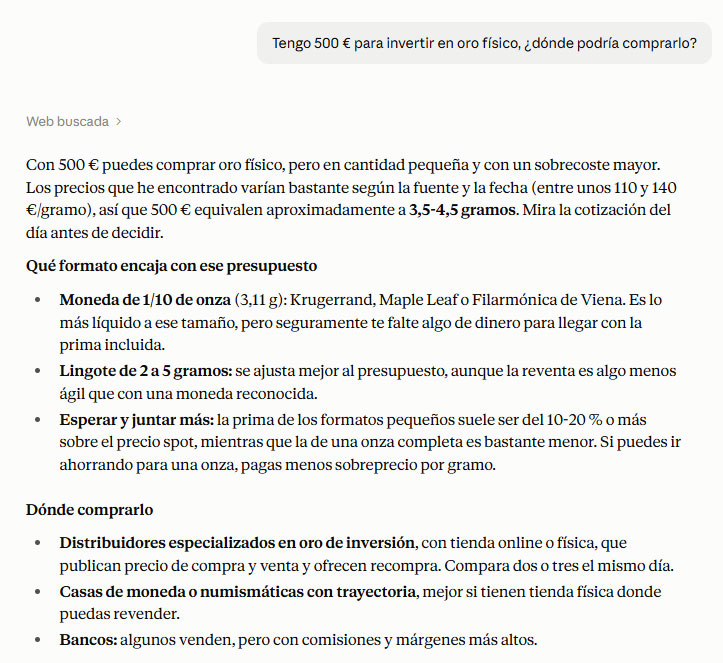
Same intention. Two engines. Two different results.
That's why it's difficult to talk about a single «position» in AI.
An AI can draw on external sources to talk about your brand
This has been one of the most interesting parts of the tests.
We asked which were the best stores to buy gold online in Spain. The AI started with information from a comparison site to help put together part of the selection, but as we gathered information about the project we're working on, went directly to its official website to discuss the catalog, manufacturers, shipping, and buyback.
In that same response, Some competitors were backed by other external sources.
This is of particular interest to us because it brings to light something we sometimes forget when we talk about GEO: A brand's authority is not built solely within its own domain.
What other websites say about it, which products it is associated with, which comparison lists it appears on, and which media outlets consider it relevant are also part of its digital footprint.
SEO, branding, and reputation They're starting to mix together much more than they did a few years ago.
How can you build brand visibility in AI?
We can work five fronts: build subject matter authority, target long-tail searches, help people understand the business, strengthen the brand outside the domain, and contribute our own expertise. None of them guarantees a recommendation on ChatGPT, Gemini, Google AI Mode, or any other AI engine—and if someone promises a formula for always appearing, it's best to take it with a grain of salt.
But they do help a brand become more understandable, relevant, and recognizable on and off its website.
Build subject matter authority
We don't need to write about absolutely everything related to our industry. We need to decide in which areas we want our brand to truly be a leader.
If you sell a specialized product, address any questions that come up before, during, and after purchasing it. If you provide a service, explain the problems you solve, the decisions the client needs to make, and the areas in which you have real-world experience.
In our example about precious metals, the task isn't to repeat «invest in gold» in twenty articles. We've been building content around different and increasingly specific questions.
It's exactly what we already do as part of an SEO strategy: building relevance around a business, not around a single keyword.
Focus on long-tail searches
The way we ask an AI a question is usually more conversational.
We don't necessarily write «gold as an investment.» We ask, «I have 500 euros—what kind of gold can I buy?» or «Which coin will be easiest to sell in a few years?».
That makes the long-tail searches and the specific needs will become even more meaningful.
It doesn't mean giving up on high-volume keywords. It means Expand keyword research and also think about questions, comparisons, situations, and real-life problems.
In our article on How AI Mode Is Affecting SEO We were already talking about this very shift toward more detailed inquiries.
Make it easier for people to understand your business
There is a less noticeable but essential part.
A website should make it clear Who the company is, what it offers, and what it specializes in and how its content, categories, products, and services are related.
Here we continue talking about Lifelong SEO: architecture, internal linking, well-structured content, comprehensive corporate pages, consistent information, and structured data when appropriate. This is what we do, for example, in the pet e-commerce sector, where we ensure that product pages include FAQs and well-structured key information.
Not because implementing Schema will magically result in a recommendation, but because make our website easier to understand It has always been a part of SEO work.
Strengthen your brand outside your domain
This part gives us more to think about after our tests.
If an AI can use an external source to explain why it includes a company among its recommendations, We can't limit our strategy to just working on our own website.
Link building, industry-specific media, brand mentions, comparison sites, relevant directories, digital public relations, or third-party content can help build a broader presence.
In the precious metals project, for example, link building and brand authority efforts have long been part of the strategy. With generative search, observe Who talks about a brand and what do they say about it? It becomes even more interesting, as we saw when the AI relied on a comparison tool to build its selection.
Contribute your experience, not just content to fill the blog
AI can generate a generic article on virtually any topic in a matter of seconds. Competing by producing more of the same It makes less and less sense.
Firsthand data, evidence, and experience with clients, examples, comparisons, product knowledge, or a professional perspective offer something that is much harder to replicate.
In fact, that's what inspired this article. We could have simply written another guide explaining what GEO and AEO are, but we preferred to check what was happening in real projects and also include the tests in which the brand did not appear.
Because those teach us something, too.
SEO and GEO: Are We Really Doing Something Different?
No, we don't see them as two separate strategies. With the emergence of GEO (Generative Engine Optimization), AEO, and all the acronyms that have come since, it may seem like we need to forget what we've learned and start from scratch. We don't see it that way: SEO remains the foundation, and what is expanding are the places where that work can generate visibility.
If you'd like to learn more about the definitions, we've already explained them in our article on GEO, AEO, and the Future of SEO, and in the one for the llms.txt file We're talking about one of the most talked-about technical measures.
In our SEO agency We work with both realities as part of the same strategy: Ensuring that a company is visible where its potential customers search for information and make decisions.
How can you tell if a brand is gaining visibility in AI?
Creating relevant query groups and observing what happens over time, not with isolated screenshots. Asking a question, getting a screenshot that shows our company, and claiming that «we’re already ranked on ChatGPT» doesn’t really accomplish much.
We don't just look to see whether or not the brand appears. We analyze:
- Why are you asking? appears and for which ones it disappears.
- What kind of occurrence is this: a citation, a mention, or a recommendation.
- What URL do you use as a source: home, category, product, service, or item.
- What external sources? appear in connection with the brand.
- In which engines The presence is repeated.
- How the result changes by changing the purpose of the consultation.
- If that visibility ends up leading to traffic, leads, or sales that we can identify.
To do this, we combine tools such as Google Search Console (long-tail and conversational queries, and pages with many impressions and few clicks), GA4 and Microsoft Clarity (traffic from AI domains and what those users do once they arrive), and Sistrix and Semrush (visibility trends and comparisons with competitors). None of these tools currently offers comprehensive AI metrics, so we supplement them with repeated, recorded manual tests.
There's something else: Not everything will end up being tracked in GA4.
If someone asks an AI which companies they should evaluate, sees our brand, and then searches for us directly on Google a few days later, it's difficult to attribute that journey. The fact that ChatGPT didn't generate a click doesn't necessarily mean that the impression wasn't valuable.
That's why measuring generative visibility still has a long way to go. What we can do right now is stop measuring it solely based on isolated instances.
SEO doesn't go away when search changes
Based on these findings, and taking into account the caveats we have noted, our interpretation is as follows: We are not replacing SEO with GEO. We are expanding the property.
A well-crafted SEO strategy can drive traffic and improve rankings on Google, but it can also build something that is now even more important: a clear connection between a brand, its industry, and the area in which it truly has expertise.
Sometimes that authority will take the form of a URL cited by Google. Other times, it will be a recommendation from ChatGPT. And There will be consultations in which we simply won't be present.
That is precisely why our question can no longer be simply, «For which keywords are we ranking?».
We also need to start asking ourselves In what areas do AIs consider us relevant?, how they present our brand, and what sources they use when discussing it.
Because gaining visibility is no longer just about holding a position. It's about being one of the answers worth considering.