You sell the same products as half a dozen competitors, at the same manufacturer's price and with the same photos from the supplier. And yet, every time someone lowers their price, your automatic reaction is to lower yours as well. It's the same old dilemma in the multi-brand e-commerce: how to compete on price without making it the only selling point, and without every price cut eating into the margin that sustains the business.
In this article, we'll explore why not all products should engage in that price war, how much each discount actually costs, and what other incentives you can offer when price is no longer a differentiator.
Same product, different business
You're selling a Samsung TV, a Husqvarna chainsaw, a De’Longhi coffee maker, or a pair of Adidas sneakers. And you're not the only one.
The same model, the same product number, and probably the same photos provided by the manufacturer. The buyer opens Google Shopping or any price comparison site and In a matter of seconds, you'll find several stores selling exactly the same thing.
The reaction seems inevitable: to lower the price. If someone else is selling it for €499, set your price to €495. If someone else lists it at €489, adjust your price again. And so on.
The problem is that this isn't a strategy. It's a downhill run in which, as a rule, the only winner is the one who can afford to lose money for the longest time. And it's not always a matter of willpower: it's one of the Most Common Mistakes in E-commerce, and probably the most expensive one.
Price matters, but it's not the only thing customers compare
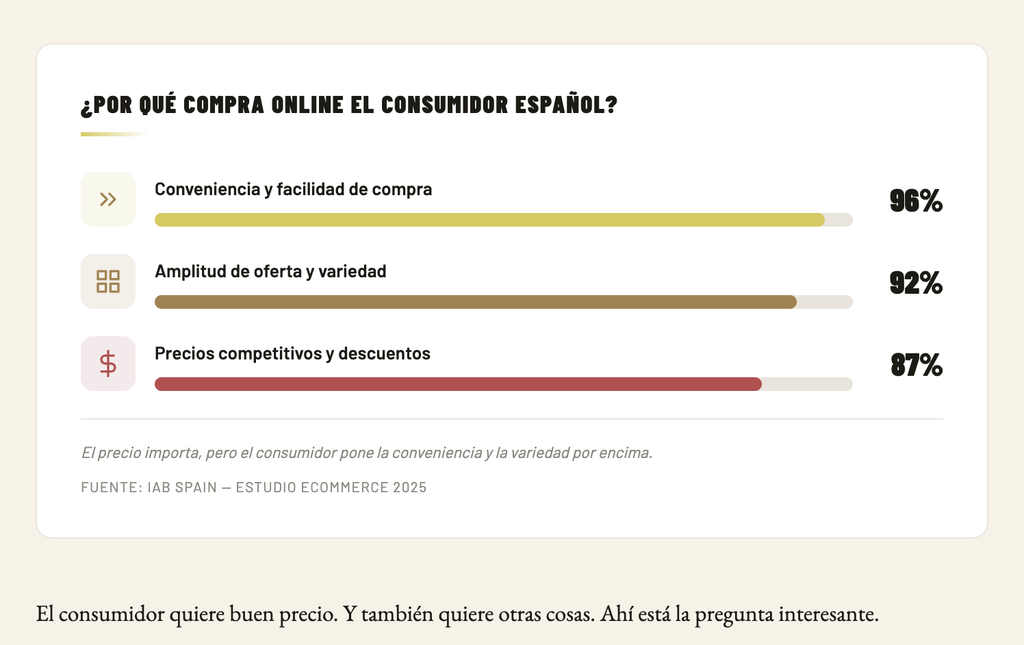
Price matters—and quite a bit: nearly 9 out of 10 buyers (87 %, according to IAB Spain, in its 2025 E-commerce Study) cite this as one of their reasons for shopping online. But at the top of the list are convenience (96 %) and the breadth of offerings (92 %).
And with artificial intelligence being integrated into the search process, the 55 % Since those who already use it for shopping particularly value its ability to compare prices, that pressure isn't going to let up.
Consumers want good prices. And they want other things, too.. That's the interesting question.
What you're actually taking away from your profit margin when you lower the price
Let's crunch the numbers—that's where you can really see what's going on.
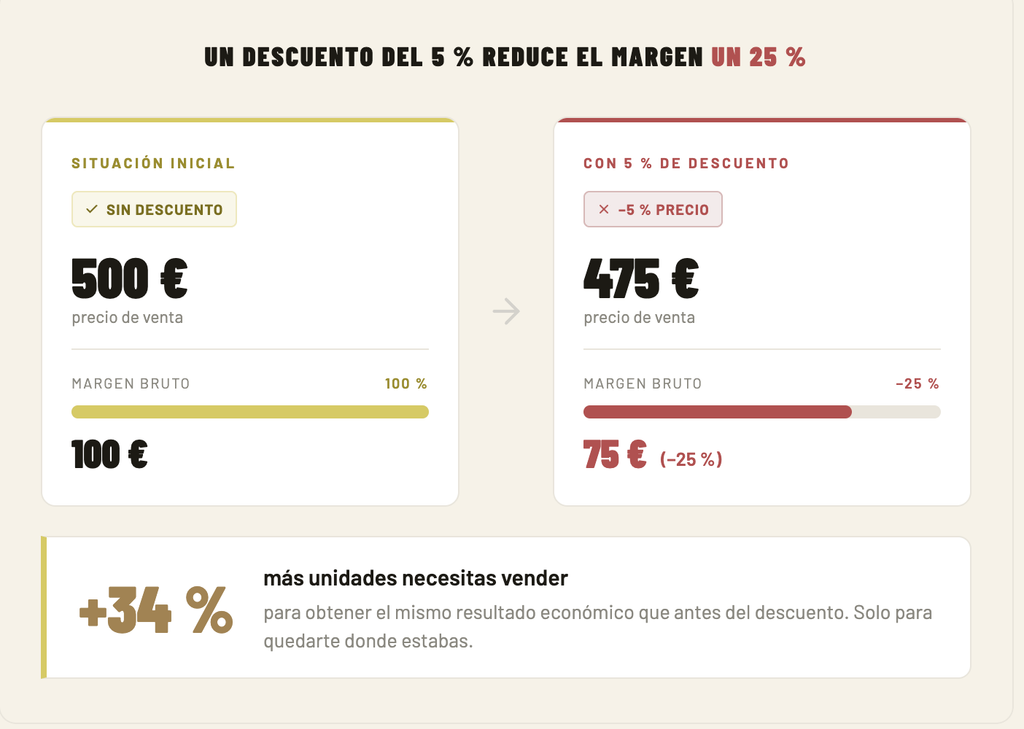
A product with a Retail price: €499 and a cost of 424 € leave a gross profit of 75 € (a 15 % markup on the retail price—a fairly standard margin for consumer electronics or small appliances). The day a competitor sets the price at €489 and you decide to match it, that margin shrinks before you’ve even spent a single euro on costs.
And we haven't even subtracted the acquisition costs yet. If we add 30 € for advertising, €10 in shipping costs covered y 5 € Taking into account payment methods and other variables—figures that are by no means exaggerated for many sectors—the contribution per order comes to €30. That could drop to €15 if the competitor adjusts its prices again the following week.
This is the most common scam at multi-brand stores: confusing revenue, advertising efficiency, and profitability as if they were the same thing. A product may have a seemingly reasonable ROAS but a real contribution that doesn't justify the effort. Another may sell much less—or not at all—and be much more profitable. Measuring Results That Truly Drive E-commerce Growth It's important to look at this actual contribution, not just the campaign ROAS.
That is why a pricing policy based solely on what the competition charges has a structural problem: it is not focused on one's own business, but on someone else's.
Key Value Items: Not all products have to win the price war
In retail, the concept of Key Value Items (KVI): products that are particularly visible, frequently searched for, and easy to compare—products based on which consumers form their perception of whether a store is expensive or inexpensive.
A shopper may not remember the exact price of 5,000 items. But they do remember how much the iPhone they've been eyeing for weeks costs, the video game console they want to give as a Christmas gift, or the chainsaw they've compared prices for at three different stores.
McKinsey & Company has observed that focusing price competitiveness on those specific products—rather than applying it indiscriminately across the entire catalog—allows for improved margins without undermining the retailer's image of competitiveness. In fact, its recommendation is that Key Value Items account for at least 15 % of the category's sales: enough to influence price perception, without having to sacrifice profit margins elsewhere.
«In which products do we need to be competitive, why, and what role do we expect each product to play within the business?»
Not all products play the same role.
- The KVI They shape price perception: these are the ones customers compare and remember, so it’s important not to miss out by a small margin.
- Others These products are related to traffic: They leave almost no margin, but they bring in visitors and data.
- The margin products They are the ones that really drive the bottom line, even though they are almost never chosen based on price.
- And then there are the recurring products, whose value lies not in the initial sale but in subsequent sales: consumables, replacement parts, and accessories.
It doesn't make much sense to expect everyone to set their prices the same way.
Two different battles: you don't win the same way against another multi-brand retailer as you do against a marketplace
When we talk about «the competition» in multibrand e-commerce, there are actually two distinct battles being waged, each with its own set of rules. Treating them as if they were the same is another reason why pricing strategy ends up being reactive.
Page 1: Another multi-brand e-commerce site just like yours
Same business model, similar or overlapping product catalog, same manufacturer SKUs. This is where Key Value Items really come into play: you don't need to win across the entire catalog; you need to win (or at least not lose in a noticeable way) on the products that this type of customer compares.

John Lewis He was forced to face the reality: when he tried to match prices with any competitor, his profit margin suffered so much that he had to withdraw the promise in 2022. When the recovered in 2024, it did so in a much more precise way, offering a price match only against a carefully curated list of 25 competitors—not just anyone—and it worked: 67 % of customers said that this guarantee, while more limited but more credible, made them more likely to shop there.
When competing against another multi-brand retailer, it's not the one who matches the most prices that wins—it's the one who chooses which prices to match most effectively..
Front 2: The General-Purpose Marketplace
Here, the rules are completely different: you're not competing against another business with the same cost structure, You're competing against a repricing engine that can update the price 2.5 million times a day and absorb occasional losses thanks to its scale. Trying to win that price war is, almost always, a losing battle from the start.
Specialization is the key to success here: BCG found that 70 % of consumers prefer to shop on a marketplace specializing in their category rather than on a general-purpose marketplace, when price and product are similar, precisely because of a better perception of service and greater trust in the brand—something that is also built through Customer reviews visible on Google.
The same principle applies to the specialty store vs. online marketplace: Think about that chainsaw. A marketplace sells it. An expert can help you understand what power you need based on how you’ll use it, the differences between battery-powered and gas-powered models, which chain is compatible, what maintenance you’ll need, and what replacement parts you’ll be able to find in the future. They don’t just sell you a chainsaw. They help you make sure you choose the right one.
That's worth something. Not for every customer profile or in every category. But in industries with complex products, high-value purchases, or purchasing decisions involving a great deal of uncertainty, reducing that friction is a real value proposition which is not included in the price.
Expanded price: what customers compare in addition to the MSRP
Customers don't just look at the number next to the "Buy" button. It also takes into account time, certainty, convenience, and the risk of making a mistake. DHL, in its e-commerce trends report, is quite straightforward on this point: a significant number of shoppers abandon their carts when they can't find the delivery options they need, and something similar happens when the return policy doesn't meet their expectations.
It makes sense, therefore, to consider a Total cost: Retail price + shipping + wait time + ease of returns + assurance that it will arrive in good condition. All of that goes through the buyer's mind when they make a decision, even if they don't put it that way. And it can tip the scales without the retail price changing by even one euro. If your website isn't effectively communicating those guarantees, that's probably why a page doesn't convert even if the price is competitive.
The first sale doesn't always have to be profitable
There's a calculation that's often used in e-commerce to determine whether a sale makes sense: revenue minus costs equals profit—and then on to the next one. The problem is that this calculation works well for individual transactions, but it doesn't always capture what happens afterward.
A customer who is satisfied with their first purchase is more likely to returnr. And that second visit usually comes with no acquisition cost, less friction, and, in many cases, an average transaction value that’s the same or higher. The math starts to change.
Bain & Company has been documenting this effect since its original research with Harvard Business School: A 5 % increase in customer retention can boost profits by between 25 % and 95 %, depending on the industry. Not because building customer loyalty is easy (it isn't), but because the cost of making a second sale to someone who already trusts you is structurally lower than that of acquiring a new customer.
Tools such as the Calculating Customer Lifetime Value or a RFM analysis to segment by frequency They help you quantify this effect in your own catalog.
However, this doesn't work the same way across all categories. A customer buying consumables (products that run out and need to be replaced) may make a purchase every month. Someone who buys a refrigerator probably won’t return for several years. And the customer who came in looking for the lowest price isn’t always the same one who later returns because of trust or good service.
That's why it makes sense to ask not only, «How much will I earn from this sale?» but also What is the likelihood that this customer will return, and what does that mean for the business?. These are different questions. And they don't always yield the same answer.
Transparency will continue to increase
And everything suggests that this dilemma is going to become more significant, not less so.
Until now, consumers had to do some of the work themselves: open multiple tabs, add up shipping costs, and read scattered reviews. Artificial intelligence can significantly reduce that effort.
It's not hard to imagine What a typical search will look like soon: «This model. Compare the final price, delivery time, return policy, and reviews, and tell me which one is the best option.»
When comparing is so easy, strategies that rely on customers not finding another price will become increasingly unsustainable. The relevant question is not how to curb that transparency, but rather What other signals can we provide when the price is clearly visible to everyone?.
The same product, your own strategy
There is no single way to compete in the multi-brand market. Some businesses are large enough to offer the lowest prices on what matters most to consumers. Others focus on the products that shape price perception and give the rest of their catalog some breathing room. Still others succeed through specialization, logistics, or simply because they manage to turn an initially unprofitable first sale into the start of a longer-term relationship.
Most people will have to combine several of these things. What's hard to sustain is trying to have it all at once.
Sharing a product with competitors does not mean sharing your value proposition, cost structure, customer insights, or logistics capabilities. The catalog may be the same. The business doesn't have to be.
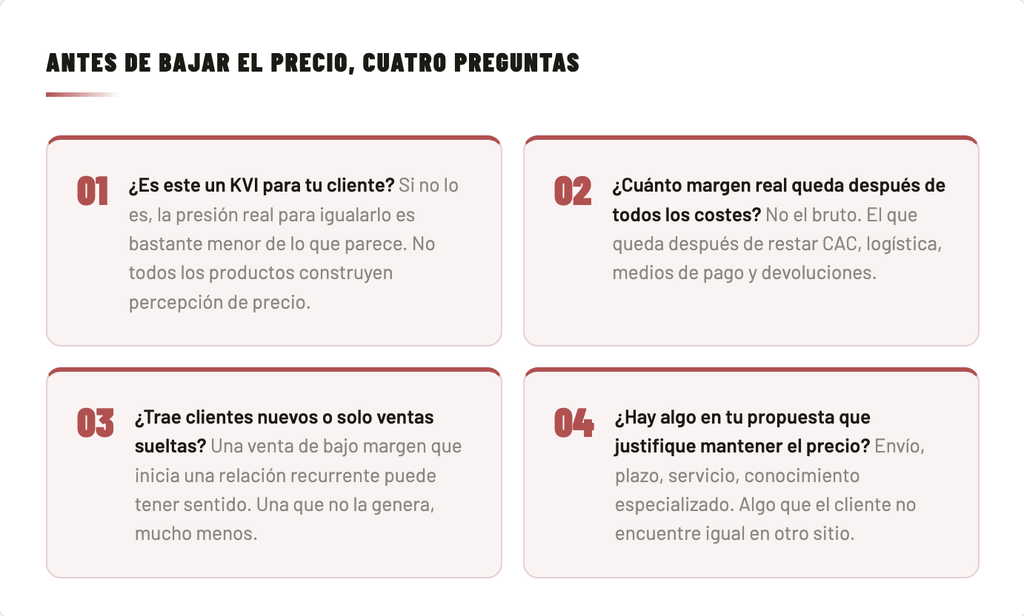
That's why, the next time a competitor lowers its price, perhaps the first question shouldn't be how much we need to lower ours. Perhaps we should start by asking: Is this a product where I need to compete on price? How much profit margin am I sacrificing? Is this bringing me new customers, or just one-off sales? Is there anything about my offer that justifies keeping me on?
«In a multi-brand e-commerce business, price will always be part of the conversation. The strategy begins when it ceases to be the only answer.»
If you need help determining where to compete on price and where not to, At Geotelecom, this is exactly what we do within our Digital Strategy for E-commerce. And if your challenge is sell on marketplaces such as Amazon or AliExpress, or reinforce everything related to the price with a brand image strategy If you want to build trust, we can help you do that, too.